Patterns

Today’s Algebra 1 class was relatively successful. This class is my most stable so far–I have had the same students in this class all week. We began with a worksheet (which I billed as “warmup”) that focused on the concept of multiplying and dividing by 1/2. Most students struggled with 7 divided by 1/2 as I expected, but many of them got it by themselves by the end.

The main task of the day was recognizing and extending patterns, with the hope of students using algebraic or geometric reasoning. I showed a variety of patterns (involving blocks, dots, lines) and asked students to both draw and count the number of objects in the next pattern in the sequence. They were then asked to predict the 10th pattern in the series without drawing the pattern. The build up was to this sequence of patterns–my apologies to the person who made this, I can’t remember where I stole this from.
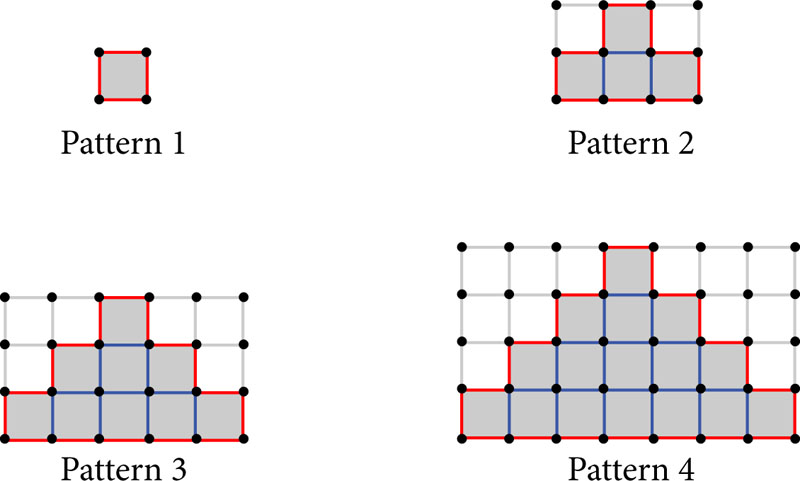
patterns5

Students were asked to draw the fifth pattern and choose something to count (white squares, grey squares, red lines, blue lines, dots, etc). They were also supposed to predict how many things in the 10th pattern. Students were seated in groups of three or four, and were not allowed the count the same thing within each group. Some students drew out the 10th pattern and counted, a few were able to predict by noticing patterns in the arithmetic progression or by geometric reasoning. However, we ran out of time and I didn’t get the quality of writing that I was hoping for. I definitely need to build in more examples of the kind of work I’m looking for so that they know what I am expecting.

Also, today was my first day using individual whiteboards. I really liked them! I could easily see students’ work from various places in the room and the best part is that I could tell that most every student was trying and could see their thinking and reasoning. What a great tool for formative assessment! This is so much better than relying on one or a few students to answer questions–you would only have information about those students. I’m definitely going to keep using this strategy when it’s appropriate.

Finally, one minor success to report: a student who was very defiant on the first day (refused to join a group of students and did not want to do any math) seemed much more open to doing math today. He was the one that wrote “F— Math” on his drawing.

Update: I got the whiteboards made very cheaply (100 1′ by 1′ pieces for about $12) at Home Depot. I used “Thifty White Panel-Board.” They were very nice and cut the panel board for me.

I am so ready for class to *really* start

I expected my Algebra 1 class enrollment to be relatively stable since I had the same kids in class on Tuesday as at the end of class on Monday. Today, I showed up and there were about 45 students in the room. There were more students than there were chairs so some were standing in the back. I didn’t prepare enough handouts and hurriedly printed more on the laser printer in the room. About 10 minutes into the class, another teacher took about 10 of them away to another class. The class started off in chaos and I never felt like I regained my composure.

Also, I made a crucial mistake in my lesson. I chose a beautiful problem (partly, because it has more than one answer) from the CPM Algebra 1 textbook as the main activity today.

CPM1-40

Students were arranged in groups of four and I told them to work together. I did not anticipate that students would not know how to calculate the area of a rectangle. There were many students who confused perimeter with area–for example, quite a few students set the living room to be a square with four sides 45 ft each and concluded that the area of the living room was 180 sq ft. Many other students didn’t know how to start and they grew frustrated and gave up because I couldn’t get to all of them quickly enough. Thankfully, there were two other teachers in the room who were helping answer questions, but none of the students were able to come up with a possible solution by the end of the period.

My Geometry class today didn’t run much better than my Algebra 1 class. Again, students were in and out of the room during class. (I noticed I had at least two students who were in both Algebra 1 and Geometry–their schedules are also messed up.) The activities that I had prepared went ok for those that were engaged, but there were a number of students who just didn’t want to do anything. Today I tried to redo the activity that I wasn’t able to do last time–finding the shape with the largest area with a fixed perimeter using string and graph paper. One student was surprised by the finding that a circle has larger area than a square with the same perimeter, so I guess it was a success at least for one student. The rest of the time, we played sprouts. Again, some were into it, the rest were not.

It was really discouraging to feel like I am mostly babysitting these students while the school figures out who is in my class and who isn’t. I haven’t given students textbooks yet as I’m not sure who is really in the class. Should I continue giving interesting but somewhat unrelated tasks during class, or should I just begin class and try to help students catch up as they join the class? What if my class doubles in size the next time we meet? How sure should I be about my enrollment before I start class? Any advice from experienced teachers would be appreciated!

RCHS standardized test results from 2008-09

At the after-school faculty meeting today, the principal showed us California Standards Test (CST) results from last year.

For these exams, students’ scores are grouped into five categories: Advanced, Proficient, Basic, Below Basic or Far Below Basic. The goal is to get all students in either the Advanced or Proficient categories.

In 2008-09, of the students that took the Algebra 1 CST, none were Advanced, 2% were Proficient. Of the students that took the Geometry CST, 1% were Advanced, 6% Proficient.

Clearly, we have lots of room for improvement!

Common Core State Standards posted

A public draft of the “Common Core Standards (an initiative of the National Governor’s Association and the Chief State School Officers) was posted today at http://www.corestandards.org. It’s worth a look.

My first day of class (sort of?)

There was more chaos today at school, but before I write about it, let me first say that I am SO ABSOFREAKIN EXCITED TO HAVE STUDENTS! I’d rather have chaos than have no students. (Don’t quote me on that.)

So… I showed up to my third period class today and there were 29 students. Hooray! Unfortunately, 30 minutes earlier the assistant principal told me that it was supposed to be an Algebra 1 class and it turned out all the kids were there for Geometry. No problem! I tried not to let my surprise show.

After we got settled, we had a semi-successful discussion on definitions for points, lines and planes for about 10 minutes. Then I was just about to start an activity where students had to draw the perimeter for a duck pen (one of the kids chose ducks) using a fixed length of fence (represented by string) and maximize area, when a teacher came in and took about two thirds of my students to another room. Apparently my class really *was* supposed to be an Algebra 1 class, and these students were going off to Geometry.

After the exodus we regrouped but just as we were about to restart, another teacher came in with new students who were supposed to be the class. By the time we got settled again, there were about three minutes left of class. <Sigh>

I think the thing that bothers me the most is that these students are being subjected to so much chaos. If my own child was in this situation, I would be a furious parent–not just about the fact that almost two weeks of instruction been lost (so far), but that the behaviors and attitudes of students are adversely affected by starting off school in such a chaotic way. I think I will have to work hard to send a message to my students, when I get them, that we are starting fresh.

I had no students in two other periods, and 20 kids show up in my sixth period Algebra 1 class. I’m thrilled and scared all over again.

Disposition towards mathematics / Two myths about mathematics

One of the most helpful things that I’ve ever read was Adding It Up: Helping Children Learn Mathematics. In that book, there is a wonderful diagram of a rope with five interwoven strands representing components of mathematical proficiency: adaptive reasoning, strategic competence, conceptual understanding, procedural fluency and productive disposition (towards mathematics).

Firmly believing that a positive disposition towards mathematics is essential for mathematical proficiency and motivation to learn, I had my students follow this prompt on the first day of (our) class: “Draw me a picture of what it looks like when you are doing math.” Here are a few of the pictures that I got.

A very typical self-depiction of disposition towards math in my class.
This was a very typical picture. Most of the pictures were of sad, frustrated or confused faces.
This student had the most positive disposition towards math in the class.

This boy's drawing is interesting in that it shows him cheating in math class.

Another representative drawing: notice the boy's work shows an "F" on it.
Another representative drawing: notice the table has "F...K math" written on it (with the K crossed out); it's probably not "F" as in the grade "F" as I originally thought.

While the students laughed and tried to make light of the pictures they drew, I don’t think that all of them drew these pictures in response to dominant cultural stereotypes about mathematics. I was in a mentally prepared to see pictures like these, but I wasn’t fully prepared to believe them. I’ve been in a funk ever since I got back from school today. My heart is totally broken.

I did follow up this activity with I call the “Two Myths of Mathematics.”

Myth #1: Some people are “good at math” and some aren’t.

Truth: With effort, anyone can be good at mathematics.

Myth #2: Mathematics is about calculating things and following procedures.

Truth: Doing mathematics involves logical reasoning, creative problem solving, collaborating with others, communicating mathematics, and much more.

My hope is that by starting the first day of class with this message, students can have a better disposition towards mathematics and more efficacious beliefs about themselves and mathematics.

TGIF

I went to school again today to sit in a classroom with no students. I’ve been told that my classes have been scheduled but they probably aren’t populated with students yet. Meanwhile, my colleagues are struggling with 50, 60+ students in their rooms with not enough chairs for everyone. Sigh…

At least I found time to work on syllabi for my classes.

The syllabi I wrote are similar to the ones that I’m used to writing, except that I included sections on class rules and expectations. I was told that students don’t really read them so it’s better not to put lots of words on the syllabus; just give the important details (no electronics allowed, percentages of homework/tests/other as part of the total grade, late homework policy, etc). I did include some very general learning objectives, however (be able to communicate mathematics fluently, become more self-motivated to learn mathematics, etc).

I met a RSP (resource specialist program) teacher today who will be teaming up with me in one of my sections of geometry to support the needs of six (?) students with disabilities of one form or another. I’m looking forward to that.

My first day of class! (sort of)

Live from RCHS, it’s Period 4!!

I don’t know what class I’m supposed to teach right now, but it doesn’t matter as I don’t have any students right now. (That is why I am able to write this blog post right now.)

I did have two students come to my Period 3 geometry class. That was exciting. My first students! Since we didn’t have enough students to really start class, I posed some problems to them that we worked on as a group (problems involving cell phone pricing plans, shapes, patterns). They both seemed to have fun and I’m glad that as one was leaving, she said that she was going to like her math class this year. (She showed me her Screen Actors Guild membership card–perhaps she’ll be famous one day.)