Distributive property

It’s been a roller-coaster week. The beginning of the week was really rough but encouragement from friends helped me recharge a bit.

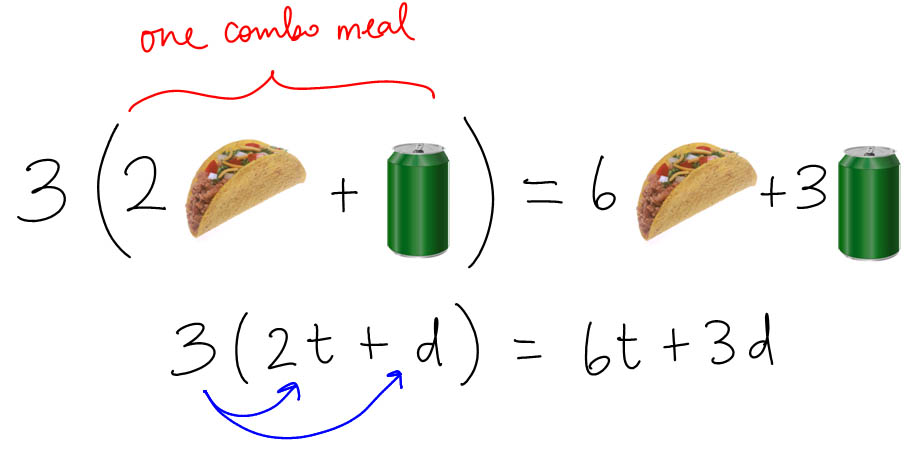
Some good progress to report today. Nearly all my Algebra 1 students were successfully applying the distributive property after a short lesson today. (Lesson involved cut out pictures of food stuck to the whiteboard with magnets.)

After a few examples like this, I asked students to work in groups and then come to the board to write out the answers to some problems involving the distributive property. Either they already knew about the distributive property, or the food analogy helped.

One week left before Winter Break.

Teaching is hard

Teaching high school is so immensely difficult. I am too stubborn to give up, but lately that feeling of wanting to give up is getting stronger.

Lots of people have been asking me questions like “What is the hardest thing about teaching high school?” I still can’t fully articulate an answer to this question, but here is a first attempt.

1. It’s so easy to stop caring. Most of the kids at my school are disrespectful to me and each other, do not care about learning, do not seem to care about their future. For these first few months, I’ve been drawing on my enthusiasm for the job and compassion for these kids (many of these kids have rough circumstances, they need someone to care for them, they need someone to explain to them why getting an education matters, etc.) to make it to work every day and try my best. Lately, my “reserves” are running empty. I put out so much energy and get so little back from the kids. The moments when I feel successful are too few and far between, and sometimes seem like delusions: one day I feel like I’m getting through to a kid, the next day he/she is behaving worse than before. The ups and downs are emotionally draining. It’s hard to keep going like this. It would be far easier to just do a mediocre job, stop hoping that kids would achieve more and feeling disappointed, and quit caring.

2. It sucks to know you suck at your job. I am fragile, prideful and have an ego. It’s a real shock going from my university where I felt good at my job and felt validated, appreciated and respected for it, to a situation in which my skills and knowledge are inadequate and I do not feel respected by students. I am good at some parts of teaching high school, in other areas I am lacking (for example, discipline). The other day I wrote about how intrinsic motivation is strongly tied to a feeling of self-efficacy–well, that applies to me too. It’s hard to feel motivated when you feel ineffectual. And when you force yourself to do something when you’re feeling unmotivated, you lose the joy of it all.

Who in their right mind would take on a job like this? No wonder the public school teacher attrition is so high.

If it weren’t for a friend and colleague who reached out to me today, listened to me vent, and encouraged me, I probably wouldn’t have the presence of mind to write these words. Our schools need more teachers like this person.

Winter vacation can’t come a moment too soon.
Horrible Monday

Mondays are hard. Each class is roughly 40 minutes long and it’s hard to get anything done. Students were so restless today, it was hard to get them to do anything. Days like this when I feel totally exhausted but that I didn’t accomplish anything. Sometimes I really hate this job and I regret my decision to do this. Sorry to disappoint, but this is the truth and it’s how I’m feeling today.

Motivating students 2

In a previous entry about motivating students, I quoted an observation from the book Adding It Up that intrinsic motivation is a largely a function of two things: how much a student values the task at hand, and whether they believe they will be successful at that task.

In my Algebra 1 class today, I was reminded of just how true this is. Most students were happily solving linear equations and I was thrilled at how many of them were doing it successfully and independently. However, one student was off-task most of the class. I walked by many times to offer encouragement and help on the assignment with no effect. Then finally, he revealed why he wasn’t working: “I don’t want to do this, mister, it’s hard.”

Aha! So I brought over another assignment involving graphing. The worksheet had 4 linear equations and students had to fill out a table of x- and y-values, then plot points. I asked, “would you like to work on this instead?” Student replied, “Oh yeah, I’ll do that; it’s easy.” He whipped out that worksheet in no time. Funny thing is that there were equations on the worksheet such as 2y+x=5 and the table of numbers had values for x given but not y so the student had to solve a linear equation to find the value of y given x.

Part of this students’ motivation to do work might have also been due to the perception of being control over the situation–I gave him some choice on what to do. However, the two choices were relatively “boring” worksheets with “naked” problems. They didn’t contain interesting problems and I didn’t try to relate the problems to their lives. They were just plain math problems.

So at least in this case, it seems that this student’s motivation is very strongly correlated to how successful he perceives he’ll be at a particular task. I need to remember this key to motivating this student and exploit it next time he’s off-task. In retrospect, I should have suspected that lack of self-efficacy was the reason behind his reluctance to work because he was in a group with two girls who showed a huge amount of mathematical growth today. He may have been intimidated to try because he didn’t want to look dumb in front of them.

Overall, today was a great day at school. I am continuing to build rapport with students and am more frequently able to capitalize on their respect for me to influence their actions and behavior.

Don’t use pipecleaners to make triangles

Today’s activity in Geometry involved building triangles with various side lengths. Students were supposed to come to an understanding of why you cannot build a triangle with side lengths 2in, 3in and 6in. It’s standard to use straws, but I was short on time to go to the store and only had pipecleaners. Don’t use pipecleaners for this activity! It doesn’t work because the pipecleaners are bent too easily and don’t make nice triangles.

Will try again on Monday with straws. On the other hand, students had fun making silly things with pipecleaners.

Student of the month

Another first today: I attended a student assembly at RCHS today in which teachers announced their nominations for student of the month. Each teacher got to nominate one student and to say a few words about the student in front of the whole school. I chose a student in my Algebra 1 class who is a pure delight–he’s overcome learning disabilities and has such a great attitude. That was the highlight of my day.

Good professional development

Today’s after-school professional develop was relatively good. The assistant principal handed out lists of students who received D’s or F’s during the recent grading period window to each teacher and we talked about specific students and general ideas for intervention. Let’s hope that the ideas that were discussed will actually get implemented. One was to start after-school tutoring that teachers can require students to attend. Other ideas had to do with students that are perpetually absent or tardy.

Neat geometry activity

Here’s a great Geometry activity relating to triangles and points of concurrency (incenter, orthocenter, circumcenter, centroid). I stole this from a friend in Utah.

Cut out some cardboard shapes. Take a shape (start with a circle) and rest it on top of something stable (like a soup can or paper cup). Pour salt on top until you get a nice pile of salt and the three-dimensional pile of salt doesn’t change anymore. (Use something to catch all the salt so you don’t make a mess.) For a circle, you’ll get a cone. For a triangle, you’ll get this.

Neat, huh? Now to all you Geometry fans out there, what are those lines formed by the ridges of the pyramid and where is that apex? Is it the incenter, circumcenter, centroid or some other point of concurrency?

It’s a very fun activity that makes these ideas relating to triangle centers become more tangible. Also very fun is trying to predict what kind of three-dimensional shape will result when you pour salt over other shapes, like a star or semicircle or the letter E, etc..

Algebra balance

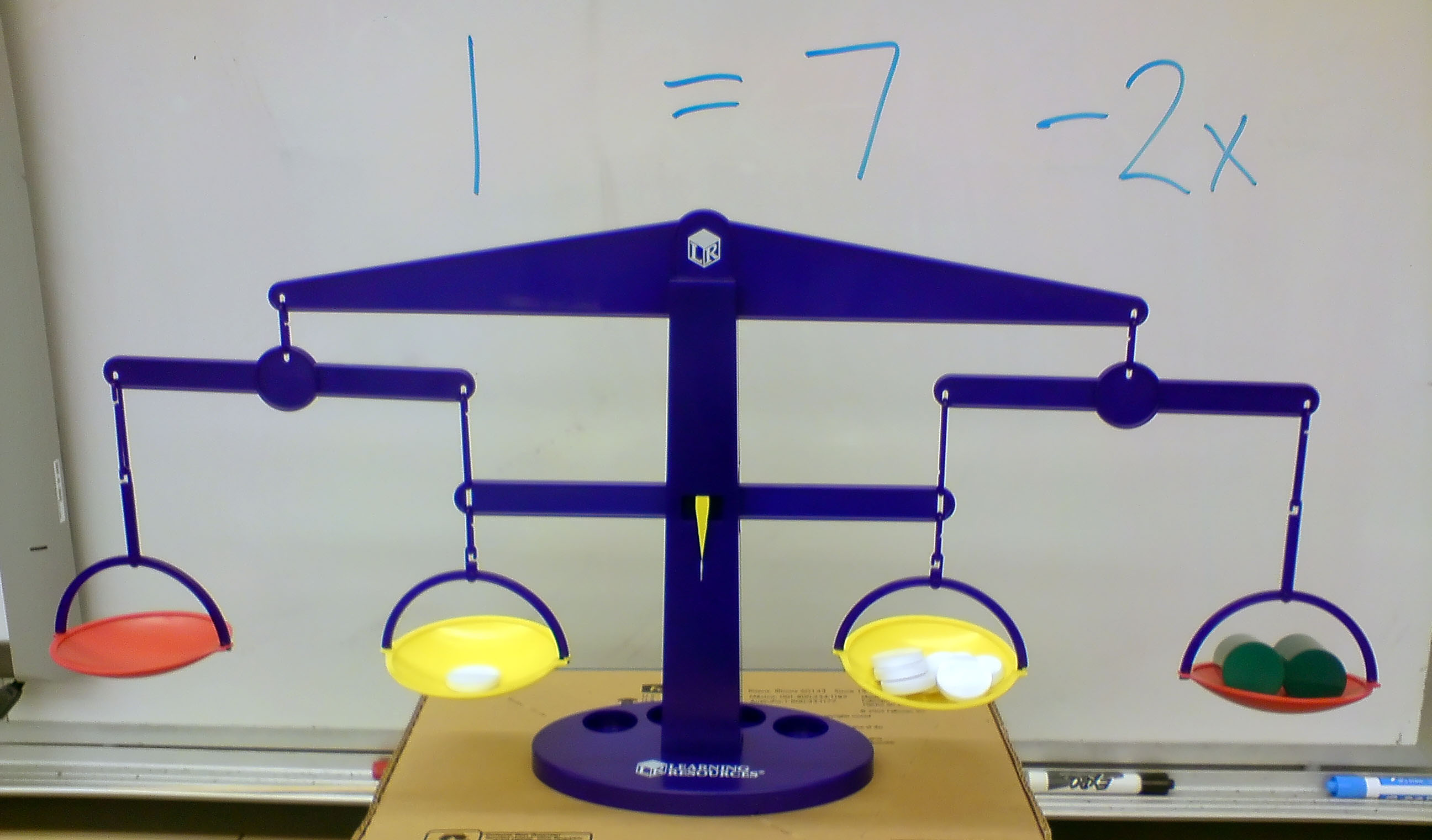
I’ve been using this algebra balance in my Algebra 1 classes to illustrate concepts having to do with equations. This balance is unique in that it has two pans on each side. The yellow pans represent positive quantities and the red pans represent negative quantities. The white chips and the green containers (representing the “x”) have the same weight so you can easily set up simple equations using the pan.

It’s been a minor hit so far. Students seem to understand that you can maintain the balance by adding or taking something away from each side of the balance. This and next week we’re working on making the appropriate moves on the balance and solving equations without the aid of the balance. I’ve gotten students used to solving equations like “2x-1=9” by inspection; the unintended consequence of this is that students are a bit puzzled why I’m going through so much effort how to add 1 to both sides, etc.

Letter for a student in jail

At the parent-teacher conferences this Thursday, I met a parent of  a student who is currently in jail. (It was good to find out why he has been missing from school for about a month.)  The parent claims that the student did not commit any crimes and asked me to write a letter on the student’s behalf. This student was a positive force in my class, and I have missed having him there. He was making good progress in mathematics. His close circle of friends seem to be harder to control in class without him there–he was a good influence on his friends as he would often be on task and they would emulate him (after making fun of him to his face).

I made sure to to write “Ph.D.” after my name in the letter. I hope this letter will help; my student’s future is at stake.