Today, I was walking down the hall and saw a student walking in a slow, strangely robotic gait. He was looking straight ahead and didn’t acknowledge me. He wasn’t one of my students and so I didn’t know him. His eyes were totally red. I asked him if he was ok and he didn’t respond.
There were two students nearby that I happened to know and I went up to them. They quietly told me that this young man was just in an empty classroom and that he was trying to hurt himself. I wanted to call security but the students only knew his first name. Also, I had my back to him for just a moment and I lost track of him. I managed to find the teacher whose room he was in and we alerted the teacher about the situation. I then had to run back to my class, which had already started.
Later, I found out that this young man’s 11-year-old sister passed away this morning. He was extremely depressed and was trying to cut his wrists. I don’t know anything else as of tonight.
Today was a scary reminder that being a teacher involves more teaching.
Every governmental agency seems to be having financial troubles right now, and the troubles only seem to be getting worse. Recently, California was disqualified from receiving federal Race to the Top funds. Our school district is planning in huge cuts.
In our usual Tuesday professional development meeting, we were asked by our assistant principal to think about our school’s priorities. Our school’s 2010-11 budget will be determined using a new process, “community-based budgeting,” and so our input was desired to help determine next year’s budget.
As with most organizations, salaries and wages are the largest portion of our school’s budget. So, naturally, we were asked to think about the functions that are necessary for our school to function. Do we need administrative staff, clerical staff, coordinators, a librarian? The answer, of course, is that we need all of those positions to function. The mood in the room quickly soured when it became apparent that this conversation about our school’s priorities was really about what positions we could cut to save money.
Tension was high. Many teachers spoke passionately about their discomfort at being asked to identify positions to cut and that many at the school are already asked to take on other functions because we are understaffed. For example, many teachers complained that they are often unable to refer students to the office because there is no one in the office; office staff are often called out to do other things so the office is locked and unstaffed.
After the meeting, morale was visibly low. I left with a suspicion that the whole conversation about our school’s priorities was really an attempt to help manage expectations–the inescapable reality is that budget cuts will result in loss of positions and the teachers and staff at this school will be asked to do more than they ever have with less; nothing in our conversation seemed like it was going to change that fact.
Yesterday, I wrote about carefully scaffolded teaching. Today, I’m writing about how my Algebra 1 students learned how to expand the product of two binomials using worksheets and zero direct intruction.
There are a number of ways to motivate the study of quadratic functions: projectile motion, number patterns (for example, triangular numbers), and areas of rectangles. I’m sure there are other ways, but these are some of the few I’ve seen.
I chose to use the area model to introduce my students to quadratic functions. On Wednesday, I used Algebra Tiles and had students review the length, width, area and perimeter of each of the three Algebra Tile pieces. (The three pieces are shown at the top of image of Page 1-front below.) I had students build various rectangles out of the Algebra Tiles on top of personal whiteboards. I had them write out the length, width, and area of the rectangles on their whiteboard while I walked around the room checking students’ answers.
The goal of Wednesday’s class was for students to see how the area model could be used to explain the distributive property. For example, the picture below is of a shape that has width 2x+3, length x. Students already knew how to calculate the area just by counting up the types of tiles, so they knew the area was 2x2+3x. I challenged them to reconcile this knowledge with the fact that area of a rectangle = length * width = x(2x+3).
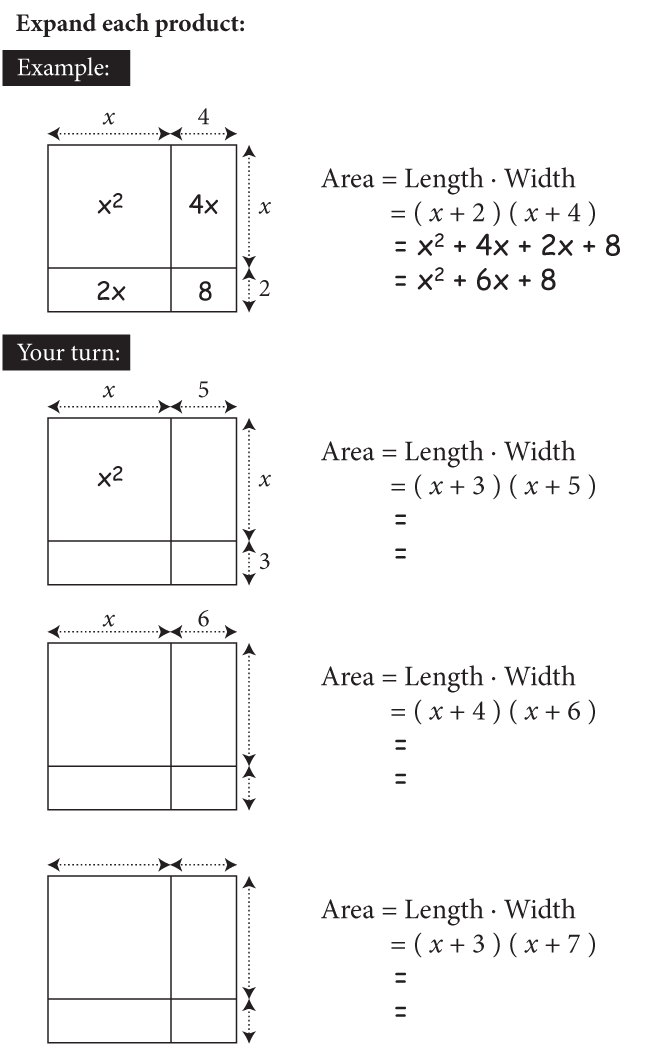
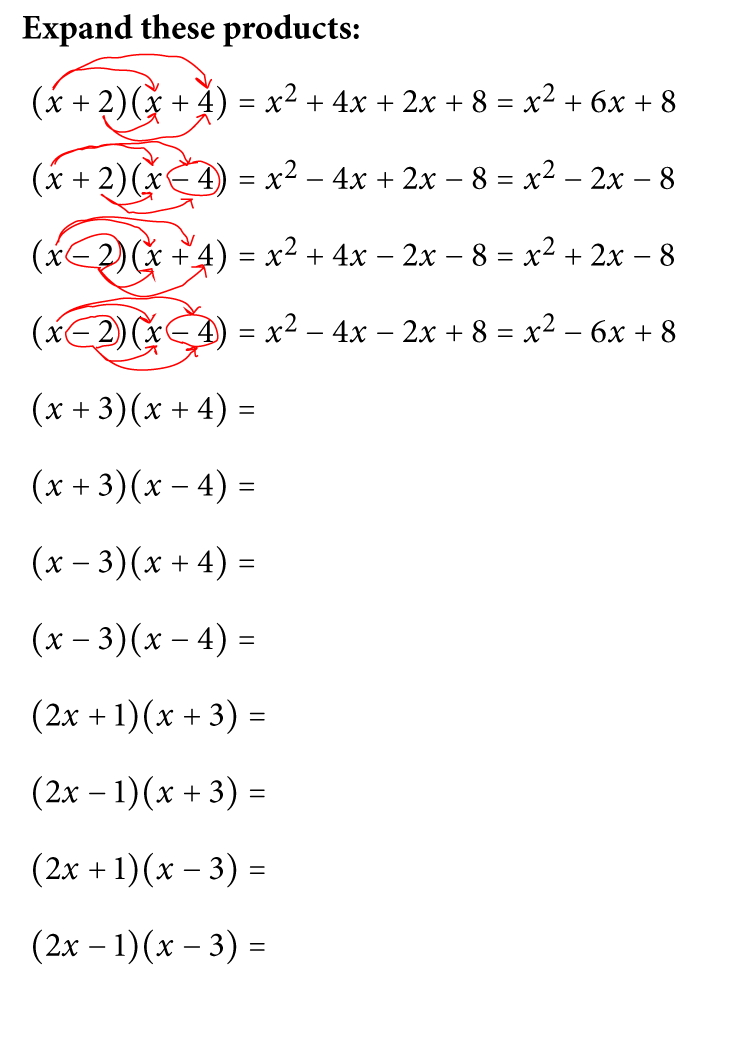
So, now that the stage is set, here is what happened today. I prepared a series of four worksheets (each double sided) to lead students to being able to expand the product of two binomials, for example (x+3)(x+4)=x2+7x+12. Each time a student finished a worksheet, he/she gave it to me to check, then I allowed her/him to get the next one. The worksheets were sitting in piles at the side of the room.
While students worked, I walked around the room, answered questions and checked completed worksheets. Depending on students’ abilities, I would either point out the precise location of errors, or just indicate that there were errors and that students had to find them.
The whole thing went more smoothly than I expected. A majority of the students were able to go from simple distribution problems like x(2x+3) to (2x+3)(x-1) by the end of the day, and most of these students did it without me saying a word to them. I asked students who finished early to answer questions for others, and they seemed to do so happily and without giving away answers. The students who did not make it through were the ones who have consistently not put in any effort this whole year.
Here are the worksheets.
Page 1 (front): Review from Wednesday--make sure students know how to compute the area of rectangles when length and with involve a variable x.Page 1 (back): Review of simple distributive propertyPage 2 (front): First examples of expanding quadratics. Note that there is one fully completed example, another partially completed. The back of this sheet has two more problems in various stages of being worked out.
Page 3 (front): Rectangles are smaller, and the widths of the pieces no longer scale with the numbers in the problems.Page 3 (back): Rectangles are even smaller now, lengths and widths are not filled in now. The last five problems have 48 as the constant in the answer. That should help students see that the constant number is the result of multiplying the constants in each binomial and that the coefficient of the "x" term is the result of adding those numbers.Page 4 (front): Now, a page of "naked" expansion problems. The red marks were included on the page to help students apply the distributive property correctly. Notice that some of the problems appeared on previous pages.Page 4 (back): First appearance of positive and negative numbers. Example shows all four permutations of signs. Also first appearance of answer with leading coefficient something other than 1.
One problem with the area model is that it becomes slightly problematic when you start including negative numbers, for example (x+3)(x-7). However, I made sure to remove the area of the rectangle as a scaffold before introducing positive and negative numbers.
So, what will happen next in my Algebra 1 class? I will need to think carefully about how far my students got, how much practice they need, and what kind of scaffolding I will provide. I may use a bit of direct instruction.
After a little more than a semester, I’ve settled on a teaching style that seems to be getting results. In a nutshell, I teach using a combination of very carefully scaffolded worksheets, activities and direct instruction. For Algebra 1, 80% of class time is taken up by worksheets, 10% activities and 10% direct instruction. For Geometry, it’s about 40% worksheets, 40% activities, 20% direct instruction. For Algebra 2, it’s about 40% worksheets, 30% activities and 30% direct instruction. What I’m about to describe definitely won’t work for everyone, but it seems to work for me.
I prefer worksheets over direct instruction because worksheets get my students to do mathematics as opposed to listen to mathematics–there’s nothing like doing mathematics to learn mathematics. Worksheets also allow me to see how every one of my students is performing. There are a number of drawbacks to using worksheets, but I think I have overcome most of them.
The biggest problem is that most worksheets that I’ve seen are horrible. They are usually a bunch of randomly generated problems with no overall structure. Worksheets are often used mainly for students to practice skills rather than to acquire skills. It’s not surprising that worksheets are often seen as busy work and have a bad reputation.
For example, here’s a worksheet from an Algebra 2 textbook on rationalizing radical expressions. I would sequence the problems differently, use different numbers, and probably add some visual aids. I would start with expressions like “6/sqrt(2)” first, rather than “7/(2-sqrt(6))”. Also, I would not choose “2-sqrt(6)” as my first denominator of that type, since (2-sqrt(6))*(2+sqrt(6))=4-6=-2. I would choose a denominator whose product with its conjugate is a positive number. I might even choose something like sqrt(5)-2 since (sqrt(5)-2)(sqrt(5)+2)=1 so that the answer would no longer involve a fraction. I like #21.
I design worksheets to help students practice and acquire skills. Doing this requires precise knowledge of where students are at in their skill development and careful attention to scaffolding, sequencing of problems and design of the worksheet. I’ll describe the general strategy in this post and share specific examples in another post.
Imagine a building with a series of pipes, wood and rope as scaffolding. A less able person trying to reach the top of the building needs more steps and guardrails than a more able person. A less able person guided by an able person needs fewer steps and guardrails than if he were to go alone. Since my goal is to have students acquire skills by completing a worksheet without direct instruction, the scaffolding that is required could be called “microscaffolding”–this is scaffolding with such fine granularity that students almost don’t even notice that they’re moving up from one level to the next.
What does this kind of scaffolding entail? Controlling number of repetitions so that students gain confidence and get enough practice; designing graphical aides, helpful visual elements, mnemonics or other devices to help students learn something, then systematically and slowly taking those elements away until students don’t need them; sequencing problems very carefully so that the level of difficulty or number of steps or number of skills involved slowly increases.
Also, it’s important to choose good numbers problems and examples. Such things have a huge effect and it surprises me that I don’t hear more teachers talking about it. For example, you wouldn’t want to have students see (x+2)^2 as the first example of expanding the square of a binomial because the answer, x^2+4x+4, has two fours, one being the result of 2+2 and the other being 2*2. (Homework for readers: What is first line that you would have students graph and why?) After teaching high school for a short while, I have definitely gained appreciation for the difference between mathematical content knowledge and mathematical content knowledge for teaching.
Another thing that I like to do is to hide patterns in the answers or problems on the worksheets. I usually walk around the room while students are working and ask them about the patterns they’re observing. Here’s an example.
Why are the answers on the left always the same as the answers on the right?
This worksheet for Algebra 1 involves substituting numbers into expressions and order of operations. The answers on the left come out to be the same as the answers on the right because the answers on the right are expanded versions of the expressions on the left. However, students had not yet learned about the distributive property at this point in class. A few students were able to figure out why the answers matched.
I don’t usually have a problem with getting students motivated to work on this kind of worksheets. Students can tell that this isn’t just busy work. They feel successful when they work on them and thereby build intrinsic motivation to work on mathematics. And, I believe that most students have untapped curiosity that drives them to like to figure out patterns. So, I don’t have to struggle with finding context for the problems that I give–I give lots of “naked” math problems and students don’t seem to mind that.
Using so many worksheets means that I go through a lot of paper. Huge amounts of paper–several pieces of paper per student per class. Putting aside the problem of acquiring or buying paper and having to make so many copies, there’s the problem of having collect and grade so much paper. Fortunately, I tend to grade work very quickly and so I am able to provide feedback to students in a timely manner. The management of paper can also be troublesome, but I’ve come up with a filing system that works for me.
One other issue is that this kind of work is very time consuming. Creating these worksheets takes time and because I’m so particular about the visual layout of words, symbols and diagrams on worksheets, it takes even more time. I design most worksheets and activities from scratch using LaTeX and Adobe Illustrator. I use these programs so that I can have complete control over layout of the worksheet. I am very picky about white space on worksheets and font size–students don’t feel as intimidated when the font is large and there are fewer problems per page. After they become a bit more comfortable with the math, they can handle smaller fonts and more problems per page. If you give a student a worksheet with 50 problems on a page and another student a set of 5 worksheets with 10 problems per page, I would bet that the latter would finish faster and more successfully.
Finally, I should mention that this idea of “microscaffolding” is not new and not my own creation. I first got introduced to this idea through Kumon, a math and reading enrichment program with franchises around the world. The secret of Kumon is its worksheets, which are so exquisitely designed that students learn mathematics essentially by themselves. I worked a number of Kumon centers during my middle and high school years.
Our school has an unusual policy concerning students who fail math classes. If a student fails a math class, the next year she/he is put into the subsequent class anyway. For example, if a student fails Algebra 1 in 9th grade, that student is assigned to Geometry in 10th grade. If the student again fails Geometry in 10th grade, he/she goes on to Algebra 2 in 11th grade.
I understand that one reason to let students move on instead of retaking a class is that it can be very discouraging to have to take a class over again. There are students who are in that situation–I know if I were in the 12th grade taking Algebra 1 for the fourth time, I would really hate math. Algebra 1 has become a huge sinkhole in California: passing it is a requirement for graduation, so many resources are thrown at Algebra 1 from every possible angle and the pressure for students to do well is commensurately higher.
However, it seems to me that our school is relieving itself of the responsibility to properly care for a student that fails a math class. By putting a student into the subsequent class, that teacher then has to deal with a student who has serious gaps in his/her mathematical knowledge. In this situation, the chances that the student fails math again is higher.
California requires that every student must pass at least two years’ of math to graduate. So, by passing students on regardless of their grade in a math class, the burden of making up those credits falls on the student and the the student’s family. The student either has to take summer classes (which are unlikely to be available in this season of severe budget cuts) or go to adult school to make up those credits.
Update: During a recent faculty meeting, I learned that the reason for disallowing students from repeating a class they’ve failed is that there is no room in our master schedule. I don’t understand this. If there are enough students who fail Algebra 1, for example, why can’t these students be put into another section of Algebra 1 with a different teacher/curriculum?
A fight between two girls broke out in class today. Thankfully, no one got hurt.
Two girls in my Algebra 1 class started having a disagreement and it escalated to the point where they got up and were in each other’s faces screaming and ready to hurt each other. I got in between the two girls instinctively, even though I’ve been told that’s not a good idea. One girl took off her shoes and stormed out of the room inviting the other girl to take the fight outside.
Just before the fight broke out one of the girls went to the restroom and two boys took her cell phone. I’m not sure if this theft was related to the disagreement that had been brewing or if it was just a coincidence. As a result of the missing cell phone, the girl refused to go to the office as I had asked and the yelling continued as now the matter involved accusations of theft.
I called security. By the time they arrived the period was over but I could not let my students leave until they were all searched in an attempt to recover the missing cell phone. Early on during all this craziness one student slipped me a note telling me who took the cell phone. I talked to the two boys privately but they claimed they did not take the phone. They also did not have the phone on them. When about half the class had been searched and let go, the girl located her cell phone, which had been stashed behind a box on one side of the room. Clearly, someone had taken her phone and hid it.
The assistant principal arrived some time during all of this commotion. He took the two boys aside after the incident and they later confessed to taking the girl’s cell phone, although they said that they didn’t know whose it was and that someone else told them to take it and hide it.
<big sigh>
I saw lots of positive things, though. First, the students who were not involved were cooperative and didn’t complain (too much) about being held up for their next class. Friends of the two girls helped them calm down–that was very helpful. I was very thankful for the student that tipped me off about the two boys who took the cell phone. I felt good that he trusted me enough to tell me. I also thanked the two boys later for being more honest about taking the cell phone.
I plan on having a talk with this class next time I see them again and will point some of the positive things that I observed. (I will also use this opportunity to remind all of my classes about the no electronics policy at our school.) If anyone else has ideas on how to address my class after an incident like this, please comment below. Thanks!
Guess what, dear readers? Today’s after-school professional development meeting was wonderfully productive!
Today, we shared lesson ideas with each other in small interdisciplinary groups. We were given a specific protocol for sharing our lessons and giving/receiving feedback. I got some very helpful feedback from my colleagues on my lesson.
I think I know what made this meeting so different from last week’s meeting: it was planned and facilitated by teachers. I’ve heard similar stories from my friends: one friend told me about how her school’s experiment at letting math teachers plan their own PD meetings was so successful that even teachers from other disciplines were coming to their meeting.
It seems reasonable that this would be the case. Administrators are under pressure from higher-ups in the district to design professional development around the flavor-of-the-month trend in education; teachers are under much more practical pressures–they want to teach well and not spend every waking moment working. Also, letting teachers have a greater sense of autonomy seems like a good idea.
This blog post is about the professional development meeting that we teachers had after school today. We must attend these meetings and, except when we get to meet with other teachers in our disciplines, they are usually dreadful.
Before I unleash my vitriol, I should note that it’s very difficult to plan meaningful professional development for teachers; it takes a lot of effort and time. It’s also very difficult to have teachers enthusiastic about meetings when they are forced to attend them. And finally, trying to get teachers to concentrate at the end of a long day of teaching is extremely difficult.
That said, today’s meeting was not productive for “structural” reasons. Here’s a blow by blow account of what happened.
(2:15 pm) The meeting begins with the assistant principal asking us to write for a few minutes in response to one of these three guiding questions:
1. “What works?” vs “What is your personal philosophy of teaching?”
2. How can our school, committed to promoting the understanding of all learners, help teachers contribute significantly toward achieving that goal?
3. What role does teacher/peer observation play in identifying the underrepresentation of key strategies and processes and existing student achievement and performance gaps?
Wow. Where to begin? First of all, #1 doesn’t make any sense. Am I supposed to respond to one question or the other, or am I supposed to respond to the juxtaposition of the two questions? I don’t know what the question is getting at, and so I have no idea how to respond. Question #2 is such a huge question that I feel completely paralyzed by it. If I am really supposed to answer question #2, I would need more than a few minutes or need the scope of the question to be narrowed down significantly.
So, I settle for question #3. I write for a few minutes and then the assistant principal asks us to share our responses.
(2:20 pm) One teacher shares his response to #2. He makes the suggestion that having time in our meetings to share lessons with each other might be beneficial. Another teacher makes the point that it’s even better when lessons are shared between teachers from different disciplines. The conversation then devolves into teachers venting about things and about whether instituting a protocol for sharing lessons would be helpful or make the process seem too formal. In the end, only one person gets to share a response to the three guiding questions.
(2:40 pm) Assistant principal moves us to the next task. We are to read a handout entitled “Investigating the Key Jobs of Teacher and Student,” write comments on it, then share our responses within our small groups. Since the handout doesn’t have anything to do with the previous three guiding questions or the previous conversation, this action sends (to me, anyway) the message that what we just did wasn’t very important. I’m wondering what those three guiding questions were supposed to guide us to. I’m also very curious to see whether the suggestion about having time to share lessons with each other actually gets picked up in future meetings–there have been lots of other suggestions brought up in previous meetings that seemed to get lots of assent but no action.
(2:50 pm) The four teachers in my group have been reading the handout silently up to this point. One teacher in our group brings up a question about what to do when all of our students perform poorly on a test. It’s an important question, but one that is not really related to the assigned task. Nevertheless, our small group has a discussion on this topic. When the principal asks for the small groups to share their responses, we hear some very general comments about teaching. The handout seems to have had little impact on the discussion. (The handout puts various teaching strategies into three categories: direct instruction, coaching, facilitative and constructivist teaching.) There is no discussion about whether some of these strategies are “underrepresented” in our classrooms.
(3:04 pm) The assistant principal introduces a representative from a local credit union who wants to help us teach students more financial literacy. The meeting ends with some announcements.
Each of us was given an agenda for the meeting. The agenda lists these outcomes for the meeting:
By the end of this session, participants will:
(1) Consider the degree to which teaching styles and strategies promote high levels of student understanding.
(2) Identify areas where particular strategies and processes are underrepresented in existing classrooms.
(3) Discuss correlations and gaps between identified teacher behaviors and student responses.
None of these outcomes have been met, except maybe (1). The feeling that I get from the agenda is that it is mainly a showcase for educational garbledygook. The meeting is unfocused and incoherent. I feel like I’ve mostly wasted my time. I can feel a growing personal aversion towards these professional development meetings and educational phrases like “underrepresented strategies” and “continuous improvement efforts.” And judging by the looks of my colleagues, I don’t think I was the only one to feel this way.
Here’s another sign that the “math wars” have intensified to a new level: a judge in Seattle sides with a parent, a retired math teacher and a professor at the University of Washington by rejecting a decision by the Seattle School Board to adopt the Discovering Mathematics textbooks by Key Curriculum Press. You can read more about it in this Seattle PI article and response from Key Curriculum Press.
The criticisms for the Discovering Mathematics series seem to line up with criticisms of “reform mathematics” in general. There are lots of people out there who believe that one should learn computational skills before concepts, that learning through inquiry or discovery is flawed, that an emphasis on concepts automatically means a shunning on . “Back to basics” is a common battle cry that is heard, and people often quote statistics or anecdotes about how poorly students are doing in mathematics “these days.” However, we frequently neglect to take a longer view of things. As Suzanne Wilson points out in her book “California Dreaming: Reforming Mathematics Education,” one can retrace the movement of the math curriculum pendulum in our country from “reform” to “traditional” and back again as early as 1830. This is nothing new, folks. Can’t we figure out how to stop having the same tired argument over and over again?
Though my school has not adopted the Discovering Mathematics textbooks, I’ve been a fan for a long time. I love the Discovering Geometry textbook in particular–I have been supplementing our geometry textbook with activities from this textbook. So, I am clearly biased on this matter.
Nevertheless, I feel I have some credibility in this matter as a university professor, as a current high school teacher, and as one who successfully learned mathematics in the “traditional” manner. Clearly, teaching mathematics in the traditional manner works–I am an example of that. However, I strongly believe that this manner of teaching mathematics generally favors the students who are already good at mathematics. I am the type of student who will try to figure out the logic behind a procedure if I can’t see why it works, but most of the students in my classes are not trained (yet) to think in this way. For these students, it is important that I try to help them learn concepts and procedures and to develop the habit of mind that leads one to ask “Why?”
Here’s a more concrete example. I could easily teach my students a three-step procedure for solving any linear equation of the form ax+b=cx+d. They would probably be able to follow the procedure pretty quickly. It is much more difficult to help them develop an understanding of what the equals sign means, why one can add or subtract something to both sides of the equals sign, and an intuition for what steps to take to isolate x by itself on one side of the equation. My experience has been that this constructivist approach has helped some students develop a much richer understanding of what it means to solve an equation. This week, a few students could explain to me, without me telling them, why any value for x is a solution to the equation 7(x+3)=7x+21. Of course, getting to this point required lots of practice on solving equations.
I believe that most of the sentiments espoused by folks on the “traditional” side of the math wars boils down to a discomfort with what is new or unfamiliar. Many of the people in this camp are parents, teachers and professors who don’t like it that current reform math education looks different from the mathematics of their youth. It seems to me presumptuous that one parent, one retired math teacher, one professor of atmospheric sciences and one judge would know more about teaching mathematics than the school board.
This decision also scares me in that it sets a dangerous precedent–does this mean that more and more curricular decisions are going to be made through our courts?
Finally, I’d like to close this blog post with a call for more calm. I wish people would stop fighting about textbooks and curricula. By itself, the choice of a math textbook cannot be a panacea or poison that will fix or ruin student achievement. This year I have witnessed first-hand that textbooks matter very little. There are so many other factors that affect my students’ mathematical performance: attitudes towards mathematics and education, life situation, self-confidence, language skills, parental support, teacher’s skill, teacher’s content knowledge, classroom environment, etc. The choice of textbook seems almost insignificant when you think about all of these things. In the language of asymptotic expansions, students and teachers have an O(1) effect on learning, schools have an O(epsilon) effect and textbooks are an O(epsilon2) effect. And even if the perfect textbook were written, it cannot teach itself; teachers would need training on how to use this miracle textbook and would want to use it. Teachers like to teach the way they were taught, teachers like to reuse things that they have used before, and teachers are under lots of other pressures to “cover” material that circumvent the recommendations of their textbook.
So, can we please stop arguing so much about textbooks now?
Every class has it’s own character that is difficult to predict and change. What’s fascinating is watching how the atmosphere of a classroom changes when students enter or leave a class. This has been happening in some of my classes because of the new semester.
In the process of growing from 25 students to 31 students, my sixth period Algebra 1 class has gotten much rowdier. Most of this is due to a new student who is very loud and rambunctious. The first day she was in my class, she told me that she hates math and is only in my class because her “judge ordered her to go to school.” She loves coming up to the front of the room and bossing everyone around as if she were the teacher.
Today, she complained very loudly about being sick and wanting to go to sleep. Since she was so loud and full of energy, I wasn’t letting her to go the nurse’s office since she didn’t really seem that sick. She left class anyway. She came back later and apologized. I’m nervous about having her in my class, but I’m also glad I get to work with her. I need to find some ways to let her get rid of her extra energy; maybe I could give her some special responsibilities or leadership roles.






 Adventures in Teaching