Making Thinking Visible

Together with Pam Mason, I help to design professional development for Math for America Los Angeles. Right now we have about 85 Teaching Fellows and Master Teaching Fellows in our program.

This year, we decided to implement something new to help “make thinking visible”–that’s my best version of what to call this thing. It’s not new, just new for us. But, I think it’s important enough to write about, hence this post.

Here’s what I mean by “making thinking visible.”

We teachers use phrases like “Say your ‘because’s” as a signal to students and each other that we care about student thinking. We want our students to understand mathematics, not just calculate, though that is important too. So when a student talks about mathematics in our class, we always press them to justify their answers. They need to say their “because”s. For example, we want students to say things like “I think the next step should be to square both sides of the equation because we are trying to find an equivalent equation without square roots.”

Well, the same thing should be true for us teachers too. When we talk to each other as professionals, we should also be making our reasoning and thinking more visible to each other so that we can learn from one another.

At least in Math for America Los Angeles, we haven’t been so good at that. We have been really good at sharing things with each other. We share our lessons, we share our resources, we share our struggles.

But when we say “I like this lesson”, do we explain why to each other?

When we say “I think students struggle here”, do we explain why?

When we say “This unit is going to take 2 more days than we expected”, do we explain why?

Some of the conversations behind these statements are actually the conversations we need to have with each other. They are meaningful and juicy because they reveal our beliefs, logic systems, and understanding about teaching and learning. If we want to really share our knowledge with each other, we should be sharing about these things rather than just sharing lessons and ideas.

Put another way, if we simply shared lessons with each other, that would be equivalent to students just telling us answers without justification. They might be arriving at the right answers for the wrong reasons! Of course we don’t want that to happen, with our students and shouldn’t let that happen for each other either.

I think making our thinking visible is not a complicated thing to do. We don’t need special training to do this, since we teachers are already in the habit of asking good questions and pressing for understanding with our students. We just have to be vigilant to do that we each other because we value each other as professionals in a craft that is deep and worthy of study.


PDEs Course: Progress Update #3 (Early Student Feedback)

Last week I used our exit ticket as a way to get feedback about the course so far. I’m very encouraged that all of the feedback was positive.

“Neat! I solved my first PDE and I’m proud.”

“This class is great so far…  I am enjoying this class more than I thought I would.”

“I like the set up of the class such that we can take the quizzes whenever and retake them.”

“I really like the class format. Still to experience this, but in theory I like the competence testing format you’ve chosen. Seems like a good system.”

“There’s a lot more focus on applications and examples than I expected. I really like this–it helps me understand why we’re doing this.”

“Good. I’m still nervous because DEs are my weak spot. But class is good.”

So I’m going to keep on truckin’.

PDEs Course: Progress Update #2

I’d like to smack the person who came up with the idea of these proficiency assessments. It is turning out to be a huge amount of work to find several PDE problems that are similar enough in content area and difficulty. So many hours invested and I haven’t even finished one set of proficiency assessments yet. ARGH!!

OK, I’m done venting. Back to work…

PDEs Course: Progress Update #1

My partial differential equations course has started!!  I have more students than I expected, but I have two amazing teaching assistants to help.

Students’ responses to the idea of the proficiency assessments has been all positive so far.

I’ve decided to structure each 75-minute class in the following way:

First 3 minutes of class: I highlight the work of some mathematicians, scientists, engineers who are using partial differential equations in some interesting way. I am trying to make sure to get a broad representation of people and some nice applications. (If you know of cool applications of PDEs, please let me know!) This is partly to help students see that this field of study is very large and active and that there are lots of people who make up this community of practice. Maybe that might even help to spark an interest or the feeling that they could contribute to this community too. This is also to give students some ideas for their application investigation paper/presentations (in which they have to investigate some application of PDEs).

Next 5 minutes of class: Short lesson on some aspect of Mathematica. We’re using Mathematica heavily in this class, and the learning curve is quite steep. In addition to this Mathematica training video that I created, I’ll highlight one command a day and have students try it out each class meeting. I’ve found this to be a good way to help students learn how to use mathematical software without boring them with long lectures about syntax.

Then we’ll launch into the main lecture for the day. My goal is to not talk for more than 15 minutes in one stretch and pause to include independent and group work time and small-group discussion.

We usually stop for a break halfway in the middle of class. (One student wrote to me that he needs to take a walk in the middle of class because he has ADHD.) Break usually involves this manatee video.

Another wonderful moment this week is that I got a lovely note from a former student with whom I had a very uncomfortable encounter that ended in tears. (Too difficult to explain here.) And, in addition to the note she came by my office to tell me that she is a very different person now from when I last knew her and that she was looking forward to class. It really made my day. ~~~

PDEs Course Design (Part 5): Inclusion and Excellence

This post is part of a series (previous parts 1, 2, 3, and 4) in which I am blogging my way through a new course on partial differential equations (PDEs) that I am about to teach… OMG… tomorrow since it’s past midnight now. What am I doing still blogging instead of getting ready for class?

Anyway, I’m guessing that most people reading my blog are positively disposed to the idea that we should work toward an educational system that provides all students with access to high-quality instruction, resources, expectations, and support so that we can achieve more equitable and excellent outcomes for all.

That last part is the part that we sometimes quibble over, even those who are in the “diversity camp”. Sometimes we pit inclusion and excellence against each other, when we should be spending more time figuring out ways to structure our system so that inclusion and excellence go hand in hand.

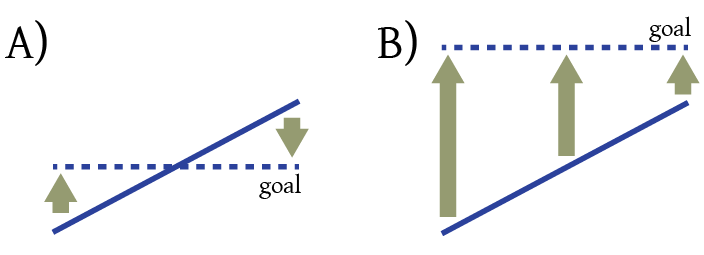
Here’s my crude illustration of the difference between these two perspectives.

inclusion and excellence

Diagram A on the left shows what happens when you try to create equitable outcomes without raising the bar for everyone: you end up improving outcomes for some and degrading them for others so it can seem like inclusion and excellence are pitted against each other. Diagram B on the right shows what happens when equity and excellence goals come into alignment. Everyone gets better outcomes. And though some might benefit more than others, the outcome is more equitable.

That’s why I’m really intrigued by studies describing interventions that improve outcomes for all and produce more equitable outcomes at the same time, like this, this, or this. (If you know of more studies like this, please let me know!)


During dinner last week, my dear friend Bill Thill (@roughlynormal) got me thinking about all of these issues. That led me to wonder, am I designing a class that pursues both equitable and excellent outcomes for all?

I’ve spent a few hours trying to sketch out a “theory of action” that links the different design elements of my course (proficiency assessments, active learning, video lectures, application project, etc.) to plausible student outcomes. I didn’t come up with much, but I assuaged myself by remembering that I was struggling to do something that the three studies linked above didn’t do either: they don’t really explain why students did better, they only observed that it happened.

So, I am about to start teaching this course with a strong reminder that it’s an experiment. I don’t know what the outcome will be, but I will try to be attentive and look for signs of trouble and success.


My conversation with Bill also reminded me that I also need to convey to my class this notion that inclusion and excellence don’t have to be at odds with each others. For example, inclusive teaching practices won’t result in a less rigorous class. I don’t intend to “cover” fewer topics than my predecessors did in previous versions of the class. In fact, my hope is for every student to achieve high levels of mathematical proficiency.

Here we go! Wheeeeeee!

Hierarchy of Student Needs in the Mathematics Classroom

(Jan 2016 Note: I’ve expanded on this post in a subsequent post.)

(Jan 2020 Note: I recently learned that there is some evidence that Maslow appropriated his theory from indigenous Blackfoot traditions. It was a good reminder to me that his theory is likely to be culturally specific and that in other cultures one might find a different set of motivations and/or ordering. For example, instead of self-actualization at the top of the pyramid, one might find community actualization or cultural perpetuity.)

Lisa Bejarano’s tweet today got me thinking.

It’s totally awesome that this student felt comfortable enough sharing something so personal. It was an indication that the student felt safe. And that got me thinking about things that all humans need.

hierarchy
(Source: Wikipedia)

How do each of Maslow’s Hierarchy of Needs connect to the mathematics classroom?

Physiological. Thankfully, many of us are blessed to teach in relatively comfortable environments where we are properly sheltered from the environment. Sometimes, the air conditioning makes my classroom too hot or too cold, but by and large I don’t have to worry about my Mudd students’ physiological needs. Far too many students in the United States, however, are food insecure. That is why, though I have mixed feelings about LAUSD’s Breakfast in the Classroom program, it is meeting an important need.

Safety. Besides the need for safety from bodily harm, I think there are two other forms of safety to consider in the mathematical classroom: emotional and intellectual. Lisa’s tweet shows that her student isn’t afraid of being made fun of, being criticized, or being outed to others (including the students’ mother!). That kind of emotional safety is crucial for students to be open to learning in a classroom. This is also why anti-bully campaigns are important.

Intellectual safety is possible when you feel that your ideas are valued by others even if they are incorrect or there is disagreement. Lani Horn is working on a book on how to develop this kind of intellectual safety in the classroom. I believe that some of the most crucial moments for fostering intellectual safety occur when reacting to a student’s incorrect answer or idea.

Belonging. I’ve been posting quite a bit here about inclusivity. I think that there are lots of things that instructors can do to help students feel a sense of belonging to (1) the mathematics classroom, and (2) to a larger community of practice of mathematicians.

  • Simply by learning students’ names early on, we give our students a sense that they belong in our class.
  • I love the holiday lights in Lisa Bejarano’s classroom–to me they exude a sense of calm, warmth and belonging.
  • At TMC15, Glenn Waddell told us about what happens when you give high fives to all of your students every day of the year. (Answer: a stronger connection with all of his students.)
  • A teacher’s sense of humor can sometimes be a great tool for helping students feel a sense of belonging–when you’re in on a joke that only those in your class can understand, that helps you feel like you’re part of a community. This video of a manatee features prominently in all my classes. It’s silly, but it’s also memorable and super effective at building community.
  • Group work can lead to amazing results, but when implemented poorly it can also lead to disastrous results. When left untreated, status issues in a group of students can lead to students feeling excluded from the group. (Lani Horn has suggestions for addressing status issues here.) Once I had the painful experience of having a student drop my class because of group work gone awry that led her to feel less skilled than her group members.

These are just a few examples of how to build a sense of belonging in the classroom. I’m sure you all have many more–feel free to contribute more by commenting below.

Esteem. The Wikipedia page on Maslow’s Hierarchy of Needs describes esteem as “a need to feel respected… to have self-esteem and self-respect.” The analog of esteem in the mathematics classroom is a student’s self-concept as a learner of mathematics. Every time a student is presented with a mathematical task, that student’s self-concept is activated in the form of an appraisal of her/his own abilities as a learner of mathematics based on prior achievements, comparisons with peers’ abilities, and perceptions of the mathematical task at hand. That appraisal of success at the task gives the student confidence or reluctance to take on the task. When I taught high school, I noticed that students with low self-concept would become disruptive or disengaged when presented with a task that they thought they would not be able to complete. These behaviors, unconsciously or consciously, help the student avoid the possibility of failure and public or private shaming from the teacher so as to preserve his/her self-esteem. (I found this old blog post from 2009 that gives a specific example of this.) At Harvey Mudd, instead of disengaging or becoming disruptive, students with low-concept will procrastinate on their work and rationalize their poor performance as due to lack of time devoted to the task.

Self-actualization. Ok, if you’re like me, you probably approach this word with a little hesitation about sounding self-helpy…. But, the according to Maslow himself, self-actualization refers to the desire to accomplish everything that one can, to become the most that one can be. That makes a lot of sense to me. When one has achieved a certain level of success with mathematics I think it is natural to wonder what else one can achieve and then to try to do it. That need to test one’s boundaries is a wonderful human characteristic.

One way that instructors can help students mathematically self-actualize is to have high (but reasonable) expectations for all students. When your teacher doesn’t expect you to do well, you’re probably not going to expect much of yourself either. I struggle a lot with conscious and unconscious bias. It is a constant battle for me to have suitably high expectations for students even when they have not met them in the past.


Maslow’s Hierarchy of Needs implies that some needs are more important than others. If we apply this idea to the mathematics classroom, then it would seem that the need to belong is more important than the need for high self-concept as a learner of mathematics. However, it seems to me that both of these things are extremely connected and dependent on one another because so often we (and our students) derive their self-worth and sense of belonging from their achievements.

How else do you meet your students’ mathematical needs in your classroom?

How Do You Know If You’re Teaching Inclusively?

I know we’re all tired of assessments, but I have some serious questions for everyone to consider:

Q1: If you’re trying to teach ambitiously and equitably and be inclusive and welcoming in your classroom, how could you determine if you’re successful?

This is a pragmatic question aimed at helping us practitioners improve. But then there’s a related research question:

Q2: What does ambitious and equitable mathematics instruction look like and can you measure it?

I hope my math ed friends will correct me if I’m wrong, but my sense is that we have some understanding of what ambitious instruction (most associated with cognitively challenging tasks) looks like but we don’t have ways of characterizing that equitable part yet, let alone measure it. A friend told me that Niral Shah and Daniel Reinholz are trying to connect ambitious instructional practices with student participation patterns–I’d be interested to know who else is working in this area.

So back to Q1…

I think there is overlap between ambitious and equitable teaching strategies that promote the learning of all students, and teaching strategies that are Just.Plain.Good(TM): those that promote students’ reasoning and sense-making, encourage students to communicate mathematically, or get students to think deeply about mathematics, etc… If some of my attempts at teaching inclusively also lead to better learning outcomes, then measuring student outcomes could be a way to answer Q1.

But, I would like to dig deeper. After all, “we assess what we care about,” right? So if we really want to change the atmosphere in our classrooms on our campuses, we need to provide instructors with a way of measuring their own progress. <DreamingBig>Maybe one day evidence of ambitious and equitable instruction might become required, important components of promotion, reappointment and tenure decisions at colleges and universities!</DreamingBig>

Here are some ideas I’ve come up with to address Q1:

  • Add some custom self-assessment questions to the usual mid/end-of-course teaching evaluation. (See examples below.)
  • Have an instructor that you trust observe your class (…but then you run into Q2).
  • Have a colleague come in to do Small Group Instructional Diagnosis (more about SGID here and here) to elicit student experiences in and out of the classroom.

Here are some self-assessment questions that I’ve drafted to augment our end-of course teaching evaluations at Mudd.

Inclusivity Survey for Students in <<course name>>

Your responses on this optional survey will help me, your instructor, be a more inclusive in my teaching and better support the learning needs of all students. I will not review these comments until grades have been turned in. Thank you for your constructive feedback!

(For each questions 1-4 there is a place to circle “Yes”, “No”, or “Unsure” and a prompt/space for students to elaborate.)

1. Students have an equal opportunity to participate in class.

2. The instructor is respectful and encourages sharing of different perspectives.

3. The instructor models gender and multicultural sensitivity.

4. The instructor, consciously or unconsciously, shows a preference for certain groups of students.

5. What could I, your instructor, do to make this class more welcoming and inclusive for everyone? What could you do?

6. (Optional)
Your gender:
Your ethnicity:

What do you all think? If you were going to design a similar survey instrument, what questions would you use?

I’ve tried the form a few times and I’ve gotten a little bit of useful information, but not a lot. Many of my Mudd students don’t really notice these things or think about them much so a lot of them leave the whole thing blank or say that things are okay.

I understand that there are limits to assessment and that it’s difficult to capture all of what happens in a classroom and try to distill it down. But, I think we should attempt to measure our attempts to teach inclusively and equitably, even if it is only just for our own growth as teachers.

What have you tried? What ideas do you have?

PDEs Course Design (Part 4): Letting Students Learn at Their Own Pace

This post is part of a series in which I am blogging my way through a new course on partial differential equations (PDEs) that I am about to teach in two weeks. (Links to parts 1, 2, and 3.)

My previous post in this series was about relieving time pressure during tests. This post is about relieving time pressure on a much longer time scale.

Last semester, one of my advisees told me something that still reverberates in my head. At the time, this student was not doing well in his classes at Harvey Mudd. We were talking openly about his performance at school when he told me, “I can learn everything here at Mudd, I just feel like I learn it two weeks after the quiz or exam.”

His retelling of his challenges got me wondering about lots of things. How intentional are we about helping students become more self-aware learners? Why is so much of our education system one-size-fits-all? Why do we require students to learn things by arbitrary deadlines, anyway? Some deadlines are out of our control: the date at the end of the semester when grades have to be entered into the grade system, for example. But most of the other deadlines that I place on my students’ learning are completely arbitrary.

After some thinking, I’ve drafted the following scheme to give students more flexibility to learn at their own pace (within the confines of the semester).

First, I took my Math 180 course objectives (previously identified in part 1) and broke them up into slightly smaller learning objectives:

  1. Given a PDE problem, be able to categorize and characterize it with enough detail so as to be able to understand how the solution might behave and to select an appropriate solution technique
  2. Be able to derive PDEs from an integral conservation law, and be able to solve a first-order PDE using the method of characteristics (nonlinear PDEs may involve shocks and fans)
  3. Given a PDE problem over a finite domain, be able to identify whether the associated eigenvalue problem is self-adjoint and determine appropriate orthogonality conditions if it is so
  4. Be able to use the separation of variables technique to solve PDE problem (including using the eigenfunction expansion technique for inhomogeneous problems)
  5. Be able to use integral transforms (Fourier and Laplace) to solve PDE problems involving infinite or semi-infinite domains, and be able to identify how general solutions are convolutions involving Green’s functions

I think I will ask students to demonstrate their proficiency on each the five objectives above primarily through proficiency assessments (PAs)–essentially quizzes with one or two tasks that are focused on only one objective above. Students can take a PA at any time during the semester. I will try to write several identical PAs for the same objective so that a student can retake a PA until s/he is satisfied with her/his mastery of that subject. Only the highest score for each objective will remain. I will try to come up with an advanced level PA for each objective so that students who want to push themselves can do so.

Students will also demonstrate their proficiency through a comprehensive final exam worth a relatively small portion of students’ final grades (15%). It will be administered as I described in part 3.

Weekly homework assignments will also make up a small portion (10%) of students’ grades, though I will encourage them to take the assignments seriously since the majority of their learning will come about through wrestling with problems.

Each student will also create a paper or presentation (thanks to Ed Dickey’s suggestion) on an application of partial differential equations that will account for 15% of her final grade. So to summarize: proficiency assessments (60%), application project (15%), final examination (15%), homework (10%).

No doubt many of my teacher friends will see some resemblance of this scheme to Standards-Based Grading (SBG), which seems to be catching on in the K-12 world. I don’t claim that my scheme is at all original. I’ve stolen ideas from conversations with many of colleagues. (Special shout out to Dann Mallet and Charisse Farr who shared their experiences using SBG at the university level in Australia.)

My primary purpose in designing the course this way is to let students learn at their own pace. I want them to be able to take proficiency assessments whenever they feel they are ready. And if they fail one of these proficiency assessments, I want them to realize that’s not the end of the story. My advisee’s experience made me realize that when I give my students only one (or two) chances to demonstrate their proficiency, (1) the pressure to get it right leads to cramming, and (2) once the test is over they don’t care about that knowledge anymore whether they learned it or not.

A true SBG implementation would also involve getting rid of summative letter grades or numerical scores in favor of a more comprehensive description of students’ abilities and understandings. I’m still stuck with letter grades here so that’s not going to happen. I’ll have to figure out a scheme for combining scores together to create a final grade. No definite plans yet on how each PA will be scored. Many SBG implementations use a rubric scoring scheme of 0/1 to 4. Right now I’m thinking that a baseline level of proficiency should correspond to a B- somehow, since this is an intro graduate level course and I need to come up with a grading scheme that works for both undergraduate and graduate students.

In my opinion, some SBG implementations are a bit too granular in the way course objectives are defined. I remember walking into one Algebra 1 classroom recently in which the teacher had maybe 15-20 mini objectives written on the wall for the unit. The objectives were small things (as in grain size, not in importance) like “express a line in point-slope formula” and “find the y-intercept of a line”. I feel this over-granulization is why some SBG implementations overemphasize the procedural nature of mathematics.

I was very conscious of that and tried to break up my course objectives into relatively large subordinate objectives. Some of the five items above are more procedural than others, but a lot of thinking and reasoning is still involved in each. The five objectives above should be relatively decoupled from each other so that students could take them in any order. (The exception is that you probably need to master #3 before #4.) I expect most students to take them in order, however, and to pass a PA once every two or three weeks.

There is still a final exam that will assess whether students can synthesize all of the information. I’m hoping that the relatively low weight of the final exam will help alleviate anxiety about the exam. The final exam will also help my students not feel completely at sea with a weird new system.

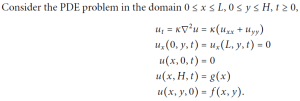
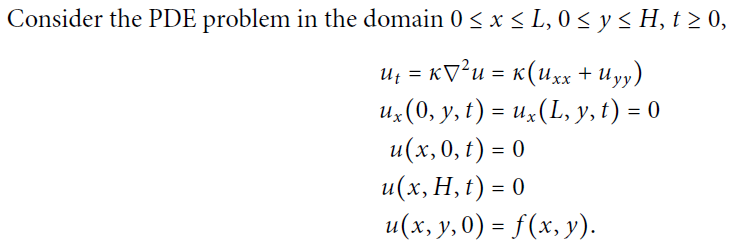
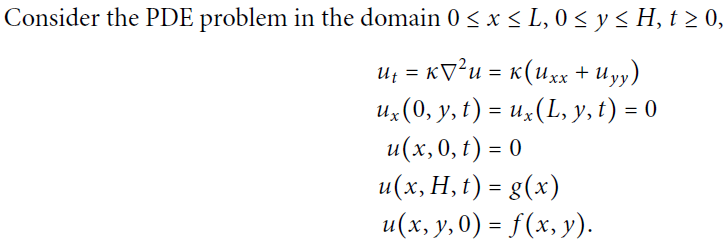
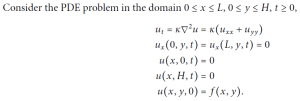
I think the biggest issue for me right now is writing all of these PAs. For each objective, I’m going to need several different but roughly equivalent mathematical tasks. That’s not an easy thing to do in PDEs. Small changes in a problem can change its complexity in large ways. For example, these problems on the surface look similar, but one is much more challenging.

Problem #1:pde1Problem #2:
pde2

Both problems involve separation of variables but problem #2 requires a change of variables first (u=v+w) where v is the solution to a Laplace equation problem also requiring separation of variables…so basically a separation of variables problem within a larger separation of variables problem.

Anyway, I’ve got lots to figure out. Your comments are appreciated!
PDEs Course Design (Part 3): Relieving Time Pressure During Tests

This post is part of a series in which I am blogging my way through a new course on partial differential equations (PDEs) that I am about to teach in a few weeks. (Links to part 1 and part 2.)

This post by Lani Horn reminded me that timed tests can be harmful for students’ self-efficacy as mathematics learners and their perceptions of mathematics as a whole. People have and will always argue for and against timed tests. In my view, most of the underlying disagreement is because we conflate automaticity and speed.

A friend told me that teaching basically involves moving students from

  • unconscious ignorance     to
  • conscious ignorance     to
  • conscious competence     to
  • unconscious competence.

Embedded in this pithy statement is some notion of automaticity: the state of having so deeply internalized a mathematical skill or concept that you know when to use it and can use/apply it correctly with relatively little cognitive demand.

A colleague of mine at Mudd often says that in calculus students finally learn all their pre-calculus skills well; in differential equation they learn all their calculus skills well. I think what he is saying here relates to automaticity too. As much as educators sometimes poo-poo it, practice is necessary for developing automaticity. The reason why automaticity is important in mathematics is that there are lots of things that build on top of each other.

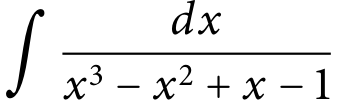
Here’s an example: To correctly perform the integral
integralone has to (1) factor the denominator, (2) decompose the rational expression into simpler fractions (which also requires one to solve a system of linear equations), (3) use a substitution to integrate one of the pieces, and of course, (4) perform all of those algebraic manipulations without making any mistakes. If the cognitive demand of any of these subordinate steps is too high, a student can easily lose sight of the forest for the trees. In this problem there are many opportunities for tiny errors. To perform this integral correctly, it helps if those subordinate skills are automatic.

With the ubiquity of computer algebra systems and online services like Wolfram Alpha, some might wonder why automaticity is still important. But, think about how frustrating it would be to read a novel in an unfamiliar language. Yes, you could slog through it by looking up the definition for every other word, but you wouldn’t suggest that as a way for someone to learn a language–it would be too off-putting for most. If the goal is just to help someone learn how to get by in a foreign country then that is fine. My goal is to help students be deeply fluent in mathematics and so I believe some automaticity is desirable and necessary.

Whether you agree with me about the importance of automaticity in mathematics, the central issue of this post is that automaticity is not the same as speed, though they are closely related. The problem is that the speed at which one student completes a task with automaticity may be different from the speed at which another student completes the same task with the same level of automaticity. To disallow that variation in speed is to assume that all students think and do mathematics in exactly the same way.

Perhaps some of the arguments about timed tests can be resolved if instructors were more forthcoming and conscious about whether their underlying goal is automaticity. And if automaticity is a goal, instructors should find other ways of measuring it without using speed as a crude proxy for it. I believe it is the instructor’s job to give students enough practice (perhaps through homework or in-class tasks) so that students have the opportunity to develop automaticity, and to help students become self-aware enough to recognize when they have internalized a skill or concept to the desired level.

The best way to observe whether students have developed automaticity is to watch them doing those tasks. My suggestion is that we formatively assess for automaticity (perhaps through in-class tasks) rather than using timed tests to do so, and to reserve summative assessments for things that don’t rely as much on the automaticity of certain skills.

Another reason why I think that timed tests are harmful is that they introduce a non-trivial amount of anxiety (which leads to lower performance) for some students, particularly those who previously performed poorly in mathematics, or those who tend to doubt their skills. In college/university mathematics courses, these groups of students tend to overlap more with underrepresented minority and female students. If you agree with these two assertions, then is it not the case that timed tests can sometimes be a form of institutional racism or sexism? Let us not forget the theory of disparate impact, which holds that any practice or policy may be considered discriminatory if it has a disproportionate “adverse impact” on persons in a protected class.

(inserting a pause here so people can think about that…)


So back to PDEs. I was considering avoiding exams completely, but given my other plans for the class (more in another post), I think it would be best to give one comprehensive final exam that will contribute a relatively small percent of students’ final grades (maybe 10 to 15%). This goal of this PDEs final exam is to see whether students can synthesize the many skills and concepts that they will need to master in this course. It will focus on the first two learning objectives I listed in part 1. I can’t avoid computations on this final exam, but I can limit the complexity of the computations and focus on problems that ask students to synthesize or evaluate ideas instead of requiring them to have automaticity of certain computations.

At Harvey Mudd, we have the luxury of being able to assign take-home exams with relatively little concern about academic dishonesty. This is all the more reason that traditional timed exams can be replaced with something better on our campus. My current plan is to write a comprehensive take-home final exam.

Here’s my usual test-writing practice: After writing a test, I take the test and time myself. I multiply that time by 5 or 6 to arrive at a suggested duration for the test. That suggested duration is clearly indicated on the cover sheet of the exam, along with instructions to students that they can take more than the suggested time if they need it, without penalty. I ask students to take the exam in one contiguous block (with only short potty breaks), and to write the start and end time of the exam on the cover sheet. There are two reasons why I give a suggested duration for the test instead of just allowing for an unlimited time exam: (1) it helps students know about how much time to set aside in their schedule to take the exam, and (2) it helps students not use an excessive amount of time. There are some students (especially at Mudd) who, if given an unlimited amount of time, would use so much time that they would neglect other obligations (like eating, sleeping, or bathing–eewww). If I write my exam so that there are no “tricks” that require creative inspiration, then there should be some hard limit to the amount of time that students can productively spend on my exams. I don’t want them to use more time than that.

Love to hear your comments. In my next post, more on reducing time pressure, but on a much longer time scale.