Mistakes made this year

There have been many times this past year when I have wished I could go back and correct or redo something. I can really appreciate the struggles that new teachers face. There are an overwhelming number of new things to consider and so there are bound to be things overlooked or mistakes made. At my usual university job, when I think of something to fix or do better the next time I teach a course, I jot down notes to myself and I read those notes before teaching the course the next time.

This time, it’s unlikely that I’ll get to teach Algebra 1, Geometry or Algebra 2 to high school students any time soon. However, I’ll still write down my thoughts anyway.

One of the biggest mistakes that I made is that I didn’t plan in larger instructional units. My lesson plans tend to be conceived from week to week, day to day. My teaching this year lacks a larger architectural design and I’m sure this manifests itself in students who don’t see the forest for the trees. I haven’t been doing much foreshadowing (preview of coming attractions) in my teaching and so there are fewer connections between topics. I also did not realize the extent to which district, state or school tests impose themselves on my instructional choices; so many times I scrambled to “cover” something before a test instead of allowing the tests to do what they are meant to do–to assess students’ understanding of topics that they have already had the chance to master in my class.

I am a big fan of “backwards course design” (espoused by James McTighe and Grant Wiggins in Understanding by Design) and have even led professional development sessions about this kind of instructional design. But have I done much of it this year? No. I feel like such a hypocrite.

Fire alarm

During the last period of school today, the fire alarm went off. This is a terrible thing, but all of us at this school have gotten so jaded by false alarms that we didn’t move for a while until someone PA system that it was a real alarm and that we needed to evacuate. We made our way to the field where we hung out for a while, then returned to class. More wasted instructional time, oh joy. It turned out two students set two separate fires at the same time in two bathrooms, so it wasn’t a drill or someone pulling the alarm for kicks.

I am looking forward to the four day weekend that has been made possible by furlough days in our district. Wheeee!!

Kids say the darndest things

While I was sick last week and out of school, my colleague got my students to write me get well cards and thank you notes. It was super awesome gesture on her part and my students wrote some really nice things.

This one really got to me, mostly because for a long time I wasn’t sure if I was really reaching this student or not. He doesn’t speak much English and he sits by himself off to the side of my Algebra 1 class. This student is in the United States illegally and he’s afraid of getting deported. He understands English better than he can speak it, but sometimes I have to use Google translate to communicate with him. I love that he only knows me as “Mister Jhon” (not my real name, obviously).

One thing I’ve learned about teaching high school: the low points can be so low, but the high points are correspondingly high too.

Was innumeracy a factor in the recent housing bust?

Here’s an interesting research article that I found by way of this article in the Economist: “The Fear of All Sums” (May 13, 2010). The authors of the paper found a strong correlation between individuals with poor math literacy and individuals who were delinquent on their loans in the recent housing bust, and this result was robust even when controlling for age, ethnicity, level of income, FICO score, highest level of education, and other sociodemographic variables. Furthermore, the authors of this study found that people with poor math literacy were not more or less prone to enter into subprime mortgages than people with high math literacy. The reason suggested by the authors for the difference in mortgage delinquency is that people with poor math literacy are not as good at managing their daily finances.

Here are the five questions that they used to measure math literacy:

  1. In a sale, a shop is selling all items at half price. Before the sale, a sofa costs $300. How much will it cost in the sale?
  2. If the chance of getting a disease is 10 per cent, how many people out of 1,000 would be expected to get the disease?
  3. A second hand car dealer is selling a car for $6,000. This is two-thirds of what it cost new. How much did the car cost new?
  4. If 5 people all have the winning numbers in the lottery and the prize is $2 million, how much will each of them get?
  5. Let’s say you have $200 in a savings account. The account earns ten per cent interest per year. How much will you have in the account at the end of two years?

I’m curious to see how my students will do on these questions. I feel a sense of personal responsibility that even if students aren’t going to learn Algebra 1, Geometry or Algebra 2, that I try to help them raise their basic math literacy skills.

I like Open House Night

Last night we had an Open House night where parents could visit their students’ classrooms and talk to their teachers.

I’ve been to two of these now and I like coming to these things. For one thing, not many parents show up, so it’s a good time to tidy up around the room and get stuff done.

Open House night is also good for my ego. At our school, it tends to be the involved parents who come to these events and there is a high correlation between involved parents and students who are doing well. These parents say nice things–it’s nice to feel appreciated. One parent told me “You’re a beautiful person.” Another told me I’m a talented teacher. I hope this fuel will last me until the end of the year.

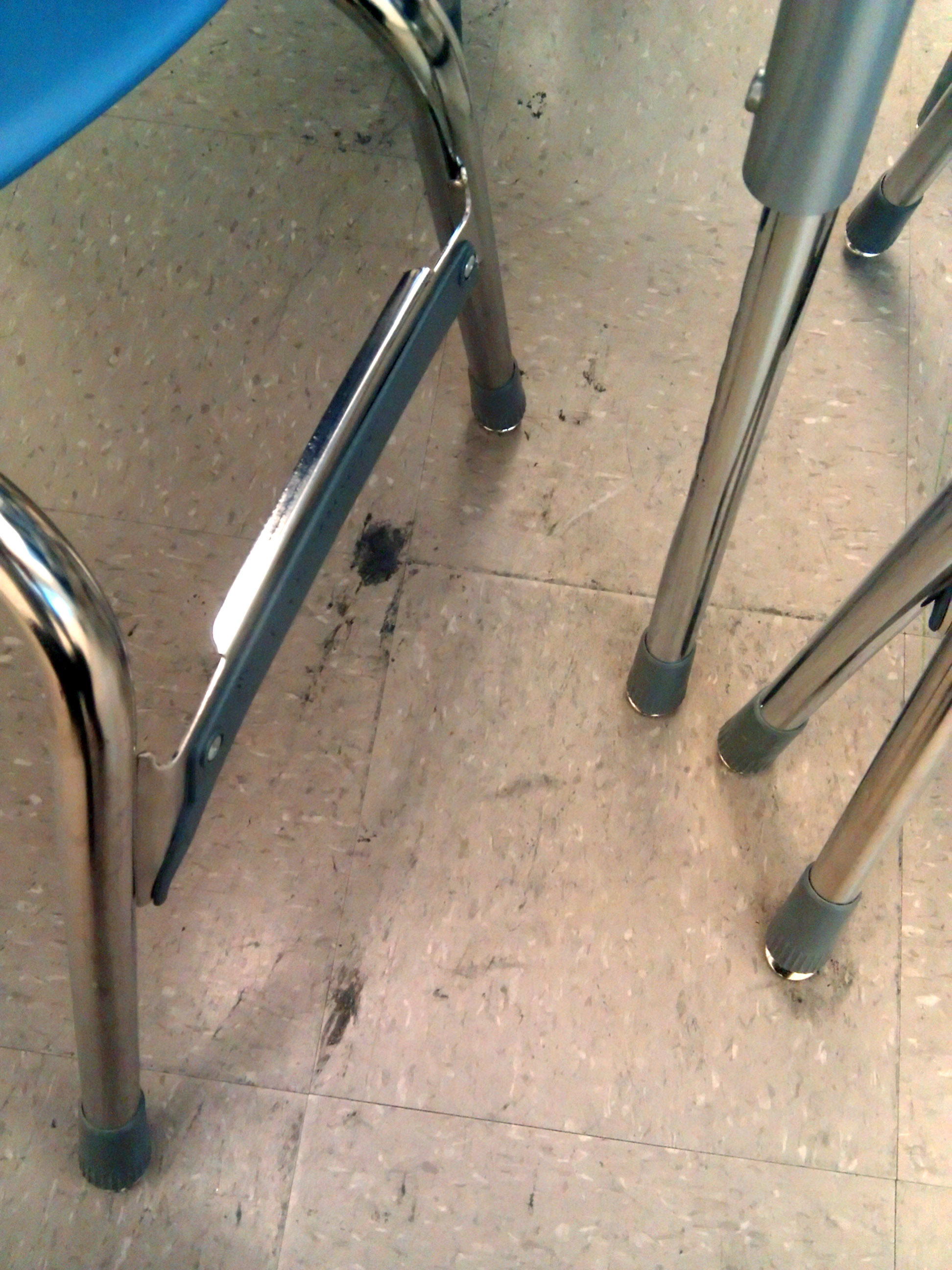
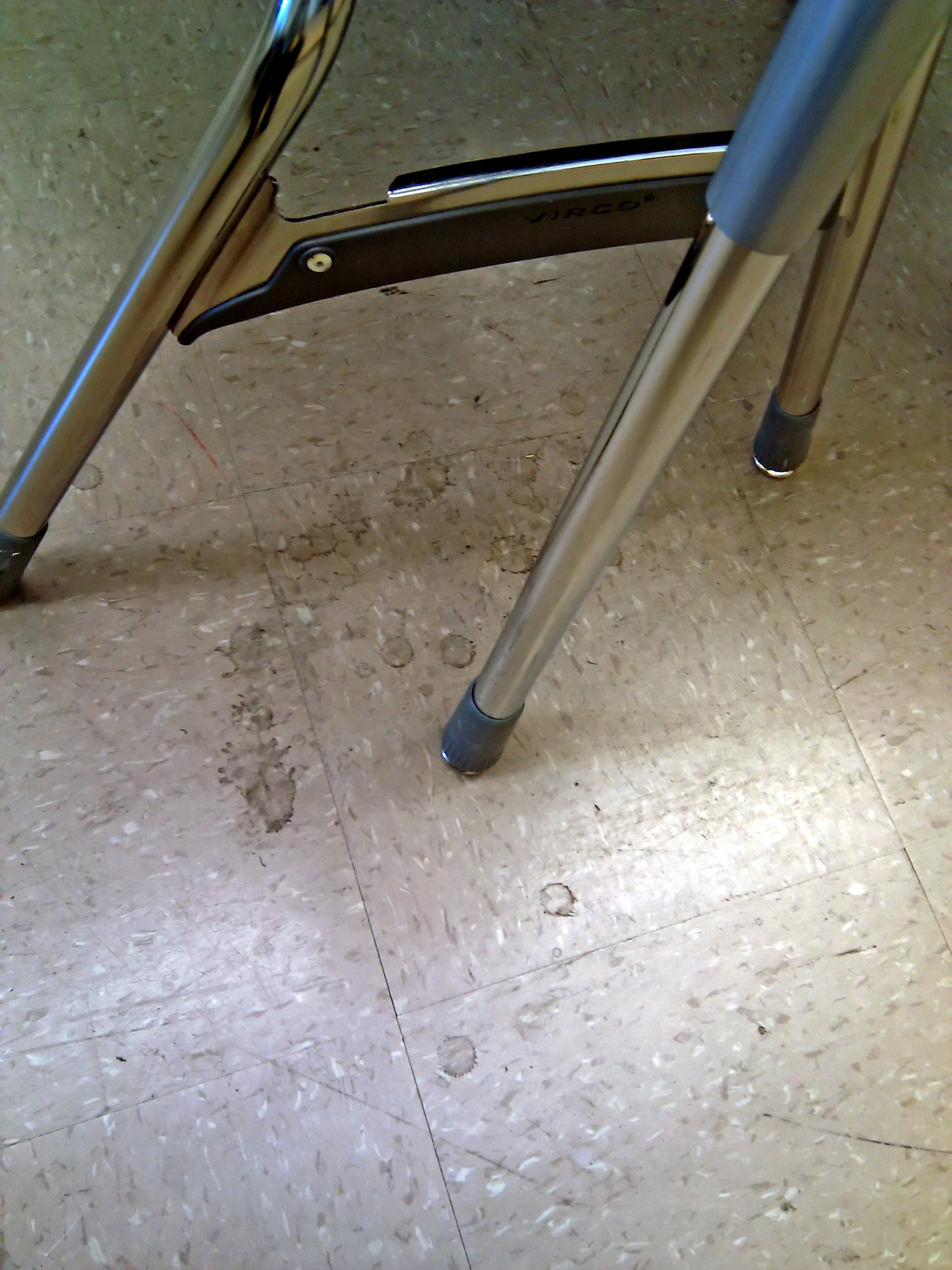
Dirtiest Floor Contest

Lack of janitorial staff and services due to budget cuts at your school? Then you may be interested in this…

Announcing: First Annual Dirtiest Classroom Floor Contest

Eligibility: Only active classroom teachers are eligible to enter

Prize: Lifetime supply of magic erasers, bleach wipes, and tetanus shots

Judges: Um.. me. I’m biased, also.

How to enter: Email unedited photos of your classroom floor to me or post a link to your photos in a comment. You must sweep the floor before taking a picture. Samples of photos are provided below.

Closing date: May 30, 2010

Good luck!

If I pull a Steve Poizner…

I heard a fascinating story today about Steve Poizner, his teaching stint and subsequent book, on my favorite radio show, This America Life. Before you continue reading, I urge you to go listen (it’s the first act of the show). It will be a half hour well spent, I promise.

. . . . . . . . . . . (30 minute break while you go listen to the show) . . . . . . . . . . .

OK, in case you didn’t go listen <a href=”insert guilt trip here”>, here’s a brief summary. Steve Poizner, high tech entrepreneur, hella-millionaire, conservative candidate for California governor this year, taught a U.S. Government class for one semester at Mount Pleasant High School in San Jose in 2002. His book, “Mount Pleasant: My Journey From Creating a Billion-Dollar Company to Teaching at a Struggling Public High School,” published this year, has met with some resistance from those who say he has mischaracterized the school and its neighborhood as a “rough-and-tumble.”

Let me first say clearly that I have not read Steve Poizner’s book, but I will try to rectify that soon. Whether Steve Poizner intentionally inflated facts to sensationalize his book is not clear–he does sound very genuine during his interview with Ira Glass. My initial reaction is that (1) it’s a case of confirmation bias, and (2) it’s very tempting to bend facts for more dramatic story telling.

Confirmation bias is the tendency that people (including me) have to assimilate evidence that confirms what they already believe, even if that evidence is inconsistent, from a source with poor authority, or just plain false. Steve Poizner argues in favor of charter schools in this book and he co-founded the California Charter Schools Association in 2003 (just after his teaching stint), so it seems to me that he would naturally favor evidence suggesting that our public schools are failing and irreparable, since that is one of the tenets of the charter school movement.

But whether Steve Poizner intentionally cherry-picked statistics and exaggerated to sensationalize or not, I can really relate to that temptation to sensationalize while writing this blog. The vast majority of you reading this blog do not know where I’m teaching and I’ve often felt tempted to bend the facts, or at least dwell on the negative aspects of my school, so as to make for more drama. If I am guilty of “pulling a Steve Poizner,” I hope you, my friends, will call me on it. At least you can rest assured that I am neither a millionaire, nor am I going to run for governor anytime soon.

Here’s what I found most disturbing about Ira Glass’s story:

“[Glass speaking]…the conclusion Poizner comes to–again and again during these scenes–isn’t that he’s doing anything wrong or has anything to learn as a teacher. Instead, he blames the kids. They’re tough, they’re unmotivated, they lack ambition, they’re wired differently.”

Hmmm…  If that’s true, that’s a bad thing. It’s a teacher’s job to try to motivate students, and teachers (dare I say, even politicians) must be life-long learners. I’m a first-year high-school teacher and I run up against my failings as a new teacher every day. I could do a much better job caring about students, designing lessons and materials that will motivate them, being patient with them. After one year of teaching, I have a better idea of what it is to teach high school mathematics in Los Angeles, but there is still so much more I need to learn about teaching.

. . . . .

Final shout-out: Many thanks to DM for a helpful chat about confirmation bias!

Frustrating Day

Today was a frustrating day. All of the teachers have been told that we cannot do any new instruction this week and can only review for the California State Tests next week. We’re going over released test questions in class, and material is admittedly a bit dry.

It feels like students are also ready for school to be over (as am I) and so they’re just a bit more rowdy and crazy than usual. They were really getting on my nerves today. One student refused to sit in his seat and after I asked him a few times he just left. It felt good to mark him as truant when I filled out my attendance. Good riddance, I thought. I feel bad for thinking that. I also feel bad that I just don’t like this kid and don’t feel like trying my best for him anymore. Sadly, I’m not patient enough for this job.

Habits of mind

The goals of mathematics education are frequently stated in terms of mathematics content (being able to factor polynomials, being able to solve quadratic equations, being able to use and apply the Pythagorean Theorem). However, as Cuoco, Goldenberg and Mark argue, it is much more productive to focus on “habits of mind” instead (“Habits of Mind: An Organizing Principle for Mathematics Curricula”, Journal of Mathematical Behavior 15, 375–402, 1996.) Some mathematical habits of mind include the predilection to sniff out patterns, counterexamples and generalizations, to conjecture, to guess, to estimate. I appreciate that the forthcoming Common Core Standards for Mathematics proposed by the National Governors Association begins by describing eight “Standards for Mathematical Practice” that differentiate novice and expert mathematical thinkers.

If I could start this year over again, I would start the school year with some more creative activities instead of diving straight into mathematical content. I would try to encourage students to get in the habit of looking for patterns, in particular. It would be so wonderful, for example, if when students see a bunch of problems like “(x-5)(x+5)=x2-25″ and “(4a-1)(4a+1)=16a2-1″, they would begin to wonder if there is something special that happens when expanding (a-b)(a+b). It’s not too late to work on these habits of mind now, but I should have focused on them more from the beginning. Oh well.

What kinds of creative activities?  For example, the other day I heard some music by Tom Johnson (“V” from “Rational Melodies”, in particular) that would be great for getting students to develop a natural curiosity for pattern. And at the National Conference of Teachers of Mathematics Annual Meeting a few weeks ago I saw some great geometry problems for developing students’ reasoning abilities. Here is a GeoGebra applet for one of those geometry problems.

Algebra 1 is hard

Today was a good day in Algebra 1–my students are on the way to factoring simple trinomials of the form x2+bx+c. Students did an incredible amount of math today, much more than normal. They seem to like it when I prepare a series of worksheets and they get to work at their own pace through them. We ran out of time so not all of them were proficient by the end of class, but we will definitely work on it more next Monday.

But, learning about factoring was not my original plan for today’s Algebra 1 class. I had originally planned to teach students how to find the point of intersection between two lines in a plane (algebraically and graphically). I had to scuttle my lesson plan because I realized just how hopelessly behind we are. My students are probably going to do very badly on the Algebra 1 California Standards Test (CST). There is just so much content in Algebra 1, and there is not enough time to get to it all. Even I feel overwhelmed about how much content there is to learn in Algebra 1.

Here is what we’ve learned so far in Algebra 1 this year:

  • arithmetic operations on positive and negative numbers
  • arithmetic commutative, associative, distributive properties (Standard 1.0)
  • simplifying an algebraic expression by collecting like terms, and using the distributive property (Standard 4.0)
  • substituting values into expressions and evaluate them using correct order of operations
  • determining if a point is on a line (Standard 7.0)
  • graphing linear functions (Standard 6.0), identifying positive, negative and zero slope
  • knowing what the slope of a line means and how to calculate the slope of a line from a graph (but I’m not sure they know how to calculate the slope between two points)
  • looking at a table of numbers in a linear pattern and being able to predict terms in the pattern and describe it with words and algebra (sort of related to Standard 7.0)
  • making connections between a pattern, a graph, an equation and a table of numbers
  • solving linear equations (Standard 5.0)
  • expanding the product of binomials, maybe polynomials too (Standard 10.0)
  • graphing quadratic functions (Standard 21.0)
  • square roots, identifying the perfect squares up from 1 to around 144
  • solving quadratic equations using the quadratic formula, but right now the quadratic formula is just something that came out of thin air (Standard 22.0)
  • factoring simple trinomials (Standard 11.0)
  • and, we also have spent time learning how to answer multiple-choice questions well

Here is what my students have yet to learn to be able to do well on the Algebra 1 CST.

  • finding the reciprocal or additive opposite of a number; calculating roots, raising numbers to a fractional powers; understanding and using the rules of exponents (Standard 2.0)
  • solve equations and inequalities involving absolute values (Standard 3.0)
  • solving multi-step word problems (Standard 5.0)
  • sketching the region defined by linear inequality (Standard 6.0)
  • understanding the concepts of parallel lines and perpendicular lines and how those slopes are related; finding the equation of a line perpendicular to a given line that passes through a given point (Standard 8.0)
  • solving a system of two linear equations in two variables algebraically (Standard 9.0)
  • more generalized factoring: finding a common factor for all terms in a polynomial, recognizing the difference of two squares, and recognizing perfect squares of binomials (Standard 11.0)
  • simplifying rational expressions by factoring (Standard 12.0)
  • add, subtract, multiply, and divide rational expressions and functions, meaning that you have to know how to find the common denominator when adding two rational expressions (Standard 13.0)
  • solving rate problems, work problems, and percent mixture problems (Standard 15.0)
  • understanding the concepts of a relation and a function, determine whether a given relation defines a function, determining domain and range of a function (Standard 16.0, 17.0)
  • determining whether a relation defined by a graph, a set of ordered pairs, or a symbolic expression is a function (Standard 18.0)
  • using the quadratic formula and being familiar with its proof by completing the square (Standard 19.0)
  • knowing that the roots of quadratic functions are its x-intercepts on a graph and being able to find them (Standard 21.0)
  • using the quadratic formula or factoring techniques or both to determine whether the graph of a quadratic function will intersect the x-axis in zero, one, or two points (Standard 22.0)
  • applying quadratic equations to physical problems, such as the motion of an object under the force of gravity (Standard 23.0)
  • knowing the simple aspects of logical arguments: difference between inductive and deductive reasoning, identifying hypothesis and conclusion in a statement, using and recognizing counterexamples (Standard 24.0)
  • using properties of the number system to judge the validity of results, to justify each step of a procedure, and to prove or disprove statements (Standard 25.0, not really sure what this standard means)

As I look at the complete list of state standards in Algebra 1, I feel completely overwhelmed. No wonder students find Algebra 1 so difficult! And as I look at the list of topics yet to be learned this year, I feel totally depressed. There is no way we can get to all of these topics by the end of the year, let alone in the remaining two weeks before my students take the CST. All I can do at this point is just try to find the topics that appear most frequently the CST and tackle those. That is why today I skipped finding the point of intersection between two lines–since the CST is a multiple-choice test, for now I will just tell them to take the four choices and determine if each point is on both lines (they already know how to do that). If the point is on both lines, it must be a point of intersection. On the other hand, factoring seems to appear quite a bit on the test, so that is why I have changed suddenly to the topic of factoring polynomials.

When you these lists of what my students know and don’t yet know, it will seem like we’ve been playing around in our Algebra 1 class. But, I promise you that I’ve been very efficient with my instructional time. We are doing math most every minute of every class, except for short breaks. And yet, we are so far from where we need to be. How did this happen?

Excuse #1. I’m a new teacher and I suck at this. My pacing is all wrong. I’m very reluctant to move on until most of my students are proficient with something–perhaps I need to move on to the next topic sooner and hope instead that accumulated review will solidify students’ skills and understanding after the initial exposure to a topic. Also, as I wrote before, I still have a lot to learn about differentiating instruction. I need to switch topics faster and find other ways to help students who need more time and practice.

Excuse #2. We’ve spent time on prerequisite skills and concepts that aren’t on the state standards, maybe too much time. For example, we’ve spent time developing fluency with positive and negative numbers, order of operations, learning how to the area and perimeter of a rectangle, calculating the slope of a line, substituting values into expressions, knowing what a square root is–these are things that aren’t on the Algebra 1 standards.

Excuse #3. We’re using the CPM curriculum for Algebra 1 in this school. Our district’s periodic assessments don’t match up with the curriculum, and the curriculum includes things that aren’t explicitly on the state standards: focusing on patterns, making connections between graphs and patterns. CPM encourages students to construct their own solution methods and concepts before the teacher tells it to them–this takes more time than direct instruction. (I firmly believe more of my students are becoming proficient because of the student-centered instruction, however.)

Excuse #4. We lost a whole month of instruction at the beginning of the year. I’m really wishing for that extra month right now.

A good friend of mine gave me some advice: Have the courage to intentionally skip topics that are on the state standards. She’s not saying that we should throw out the state standards (even though I’m not crazy about them). I think what she is saying is that I should trust my intuition on what I think is best for my students and not feel bound this list of topics. If I try to cover all of the material, we would be going so fast that most of my students would probably not get it (at least not with my current teaching skills) and so I’d be setting them up for failure. I should instead focus on a smaller set of topics and make sure my students really know it well and feel confident about themselves.

Argh! There is so much that I would do differently if I had the chance to start the year over.

One positive thing–last year, only 2% of students at this school were deemed “Proficient” by the state in Algebra 1. There’s no way my students will do worse than that, I’m confident of that.

—-

By the way, who in California decided that the pinnacle of knowledge in Algebra 1 is knowing how to derive the quadratic formula by completing the square? When you look at the released questions for the CST, it certainly feels that way.