IT issues / copying / students helping each other

Our school district is large and uses a centralized web-based system for taking attendance. I think it’s interesting that this system has a separate web page to tell users whether the service is working properly. Hmmm… Any guesses from readers about what this means about the reliability of the service?

A minor setback over the weekend. The copier is in our school’s office. The office is often locked during school because staff or admin are not there. When us teachers need to make copies, we have been relying on the teacher who room is next to the office to let us into the office through his side door. This is really not a good solution and the teacher, rightly so, has decided not to allow us to come through his room. So now, our ability to make copies is restricted. We found out today the copier is out of toner, so maybe it doesn’t matter anyway.

And now nice anecdote to end the post: Today in third period, I noticed one of my students (who previously complained about being in a group with people she did not know) helping another student. She was explaining things methodically and not just giving the other student the answers. She was doing it so earnestly and she seemed so pleased that she understood the material enough to be able to explain it. I thanked her for her thoughtfulness at the end of class. Hooray!

Lots of learning = Good day

I leave school feeling encouraged today because of the amount of learning that I saw.

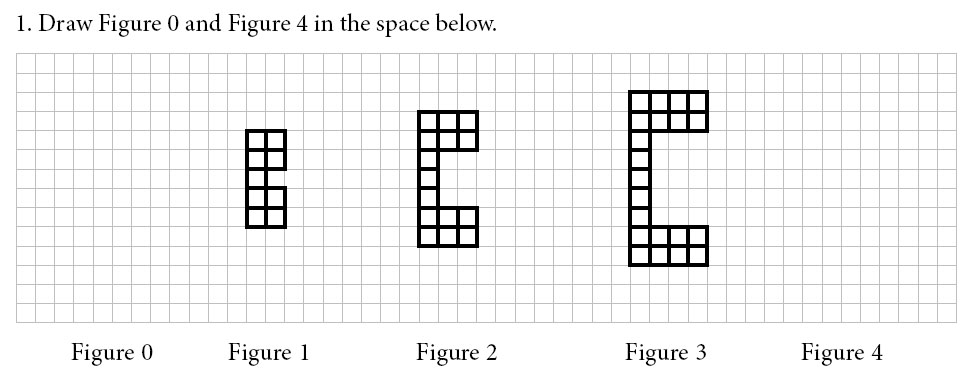
Today, in my third period class we started working on making that “Cartesian Connection”–connecting a patterns with graphs with algebra with tables. It’s a central part of the CPM algebra curriculum.

Most of my students were able to successfully look at a table of numbers such as

x 0 1 2 3 4 10
y 3 9 15 21 27 63

and generate a rule for it: y = 6x + 3. This is something they could not do just a few days ago. And they seem to be really understanding. Some of them were able to explain to me that the reason the “6” is where it is in the algebraic rule is because the pattern of blocks grows by 6 each time.

pattern6

But here’s the thing: Sometimes I worry that if any of my colleagues or administration were to walk in my class, they will think the class is out of control and that no learning is happening. Certainly, there was a lot of talking and lots of movement. Students find it hard to sit still for a long time. But, there was still a great deal of work and learning being done–more than I’ve seen in this class in a while. Furthermore, there were lots of meaningful mathematical conversations taking place. Students were saying things like “I think it should be 6x+3 because…” or “I think Figure 0 should have 3 blocks because of the pattern of numbers…” I’m sure I have a long way to go in developing classroom management and effective discipline, but I’m okay with a noisy classroom if there is real learning happening. I made sure to give positive feedback to the class on their good effort.

In geometry, today we learned about the incenter (intersection of the angle bisectors in a triangle) and learned how to construct it in two ways: using patty paper and using compass and straightedge. Again, there was a good deal of learning taking place today. Many students were able to find the incenter using compass and straightedge, and that is a relative intricate task for them. We ended the class with some dynamic geometry software on my tablet computer and the students seemed to enjoy that.

So, a good day overall. Someone please remind me about days like this when I feel like quitting.

Continuation school

Had a number of students transfer out of RCHS to a nearby continuation school this week. I’m hoping that if a student is taking the effort to transfer that he/she is serious about finishing high school. I wonder what students say to each other about continuation schools.

Yucky Monday

Not a great way to start off the week. Lots of resistance and defiance from students today. Few stand out moments.

In third period, we (me and the resource teacher) instituted seating charts to get students used to doing group work. One student was very publicly criticizing her group: “I don’t like my group and don’t want to work with them.”

In sixth period, one student was texting during her class. It took about 2 or 3 minutes before she would give me her phone. She’s very mature and very emotionally manipulative and the interaction totally drained me. (“Well if I’m going to give you my phone I don’t want your dirty hands to touch it so go get some paper to wrap it first.”)

It’s also discouraging to see how many students complete their homework, even after I explain how important it is to practice to get good at math.

Days like this really make me dislike my job.

Making inroads

I stole a great activity from my colleague for my Math Lab this week. It involved making collages to represent the things that we need in our lives and the things that we need to learn math. Students were first asked to select things they need in their lives from a list of words containing things such as “security,” “play,” and “be to understood.” Then they cut pictures out of magazines and decorated their collages.

Most students enjoyed the activity, some even asked if we could do more collages. However, there was a group of boys that did not want to do the activity. Perhaps it was peer pressure or the fear of looking appearing “good” or studious in front of their friends that prevented them from working. This group has so far not participated much in class.

There seems to be one girl who is in this circle of friends. She was one of those who enjoyed the task and asked to do more. After class, she happened to linger in the room and I took the chance to chat with her briefly. I asked her to be on the look out for ways to engage the boys in her circle of friends in class. She seemed to be on board. Stay tuned…

“Teaching to the test” (Updated)

One of the arguments against greater school accountability and performance-driven school reform is that the introduction of more tests to measure student performance will lead to more teachers “teaching to the test.”

I’ve been thinking about this a lot lately as our district’s first periodic assessment is coming up this week, and us teachers were given a copy of the exam so that we can prepare our students for it. I’m a bit nervous about my students taking the exam as we are behind where most other students should be in an Algebra class or a Geometry class. After all, we lost almost a month of instructional time at the beginning of this school year due to constantly shifting enrollments.

Do I prepare my students for the test or not, and if I do, how will I prepare them? It’s not just a matter of wanting my class or my school to have higher scores–if students see their low scores they will lose some of the  precious confidence in their math skills we’ve been building so far, and confidence (specifically, belief about self-efficacy) matters a lot.

So I’ve been wondering: what exactly is “teaching to the test” and what is it about “teaching to the test” that carries negative connotations? Standardized tests often ask students to think about mathematics or to decode mathematics presented in peculiar ways. If the content of these questions is something far removed from a teachers’ usual curriculum and the teacher is compelled to help students acquire that content, is that bad? What if that content is potentially helpful or useful for students’ mathematical development?

Consider one of the test questions on this week’s periodic assessment: (I’ve modified it slightly for this blog.)

Which is greater, 5x+1-(1-2x) or 6+2x-1-(2x-4)?
A. 5x+1-(1-2x)
B. 6+2x-1-(2x-4)
C. Not enough information
D. They are equal

This question requires students to be able to combine like terms, to be proficient with positive and negative numbers, and to reason about which of the two expressions is greater. We’re still working on combining like terms and adding and subtracting positive and negative numbers in class so would that be considered “teaching to the test”? (Doesn’t seem like it.)

To help my students answer this question successfully, I would probably have to start them off with questions such as

Which is greater, 7x or 9?
A. 7x
B. 9
C. Not enough information
D. They are equal

If I pose questions like this, am I “teaching to the test”? Seems to me a moot question. If I find the content compelling for students’ mathematical development, then I will help them learn it. If not, I’ll let students struggle with the question and let the test question do its intended job: give me information about my students’ understanding and skills.

I think what I’m trying to say through this post is that “teaching to the test” is a catch phrase that galvanizes people in educational debates, not unlike the phrase “public option” in present U.S. debates about health care reform. It seems to me that the kind of teaching that tests encourage is mostly determined by the content of the those tests. Test writers have a great deal of power as they can shape what is taught in classrooms. A bad test could potentially fill math classrooms everywhere with useless, unimaginative content. A test could even be used to circumvent state and district standards for mathematics as it can establish a de facto curriculum. And let’s not forget that developing a good test can be expensive.

Closing side note:  What I find fascinating is how teaching happens on so many scales at once. The public and academics mostly talk about teaching at macroscopic scales (districts, curricula, schools, classes) but when you think about what actually happens every day in every classroom, it’s what the teacher does and says and how students process it that really matters. How will Teacher X’s beliefs about what mathematical topics are important affect the way she or he prepares students for a standardized test? How does Teacher Y’s beliefs about the way students acquire knowledge affect the way she or he implements a curriculum? Will Teacher Z maintain the high level of cognitive demand in a rich curriculum like CPM? And who is watching/can watch what happens in every class every day?

UPDATE: A friend astutely reminded me that in the “backward” teaching design process, we (1) think about what it is we want students to learn, then (2) determine acceptable evidence for students achieving those goals, then (3) plan learning activities and experiences. (I believe strongly in this design method and try to follow it when I can.) This design process necessarily involves preparing students in step (3) to do well on the assessments determined in step (2) so if that is considered “teaching to the test” I would be guilty as charged.
Monday: Fatigue

Monday morning, here I am at school again. Why didn’t I take a “normal” sabbatical like other people do? Am I going to make it to June if I already feel this way in October? Is it wrong to complain seeing as how real teachers don’t even get the chance to have a sabbatical?

Almost all of the teachers and professors I know struggle with balancing their work and personal lives. We work during the day, then go home and work some more. It’s hard to keep this kind of effort going, and I’m not as energetic as I once was.

Glad to be back

Today was my first day back in the classroom after being out of the country for a few days. The substitute teacher did an excellent job. I’m glad to be back, and missed seeing my students.

Students didn’t do so well on the first quiz that I left with the sub. I expected as much, however. The school is asking all departments to make common assessments and we put these things together at the last minute. Some of the questions on the test were on topics unfamiliar to my students. I told my students that the quiz will be a “practice quiz” and that we will take another quiz next week.

After talking with one of my colleagues, I’ve decided that the approach to take for my Math Lab class is to help students enjoy mathematics. I’m not going to try to make it my goal to help them learn any particular math content or to even get a good grade in their math class. I hope those things will happen, but I’m not going to make it my primary goal. We will do fun things, and I have decided that I need to enjoy the class too. I can’t be dreading this class for the whole year.

Parent’s night

We all stayed late at school tonight for Parent’s Night.

I met about 8 or 9 parents tonight. Many of them couldn’t speak English and relied on their children to translate for them, but I felt that I got to form an important connection with each of them. I told parents about our classroom rules, how they could get in touch with me, and most importantly, how to help their children in mathematics (ask children to explain their work to parents, reinforce positive attitudes towards mathematics by combating the “I’m just not good at math” myth). I also warned parents of Algebra 1 students that the CPM book looks very different from a traditional math text book and assured them that students will learn a lot from this approach. I didn’t tell parents anything about my background or reasons for teaching math; just felt like that wasn’t really important.

I’m also off to a workshop so won’t be updating this blog for a few days. I’m hope my sub has a pleasant, stress-free experience.

Shooting (updated)

Another first today: lock down and shooting

A female ninth grader was shot half a block away from school just as school let out today. The student was not critically injured. Police descended on the campus and we were locked down for about 90 minutes while they searched for the suspects.

In other news, students are still being shuffled around between classes, though my enrollments have been relatively stable. One colleague just had one of her classes changed into a new section of geometry. This is already the sixth week of school. Many colleagues are frustrated and teacher morale is low.

Update: A student in one of my classes claims to be a friend of the girl who was shot, and told me that the bullet was not intended for this girl but for someone else. School seemed to run as normal the next day, students didn’t seem affected. Perhaps it shows that these students just see these kinds of things as part of their daily lives?